TOPICAL EXAMINATIONS: CLASSIFICATION
NAME………………………………………..CLASS……………………………………………….
TIME: 21/2HRS
INSTRUCTIONS:-
- This paper consists of sections A, B and C
- Answer all questions
- All answers must be written in the spaces provided
- All writings should be in blue/black inks except for drawings that should be in pencils
SECTION A.
- Which of the following does not belong to kingdom plantae
- Bryophites
- Pteridophytes
- Basidiomycotes
- Angiospermaphytes
- Identify the wrong statement about monocots
- Have taproots
- Have paralle venation
- Floral parts are in three or multiple of three
- Lacks pith on the stem
- Which statement is true about dicots?
- Has one cotyledon
- Has cambium in stem and roots
- Floral parts are in four or six and their multiples
- Leaves are narrow and flat
- which of the following is not a distinguishing feature of pine?
- Needle like leaves
- Male and female parts on the same plant
- Lack flowers and fruits
- Their seeds are well covered
- which of the following is a disadvantage of conifers?
- Are source of timber
- Are source fungus in soil
- Add manure to the soil
- Extensive root system affect other plants
- which statement is true about monocot root and stem?
- Vascular bundles forms a star shape
- Have pericycle and cambium
- BOTH has pith
- In stem, the vascular bundle are scattered while in roots they form a ring.
- Which of the following is not a dicot?
- Banana
- Coffee
- Tea
- Eucalyptus
- Which of the following is not an advantage of angiosperms?
- They are source of food
- Some have medicinal values
- Acts as wind breakers
- Sources of timber.
- Which of the following is an characteristic of kingdom Plantae?
- Have chloroplast
- Have vascular bundles
- All members can photosynthesize
- They produce asexually
- In dicot root, the vascular bundles are arranged in such a way that;
- They form a ring
- They are scattered
- They form a star
- They appear random
2. MATCHING ITEM QUESTIONS.
|
LIST A |
LIST B |
|
|
SECTION B.
3. Describe five distinctive features of kingdom plantae
4.a) Mention two members of division coniferophyta
b) State the distinctive features of conifers
5. a) Briefly explain how fertilization takes place in conifers
b) Outline the advantages and disadvantages of confers
6.Using well labeled diagrams, show the differences between monocots and dicots
7. Explain using diagrams the differences in the arrangement of vascular bundles in monocots and dicots
8. Discuss the advantages and disadvantages of division angiospermophyta.
9. a) What is alternation of generation?
b) Explain how alternation of generation takes place in bryophytes.
10.Write an essay on economic importance of kingdom plantae
TOPICAL EXAMINATIONS:MOVEMENT AND LOCOMOTION
NAME………………………………………..CLASS……………………………………………………TIME: 21/2HRS
INSTRUCTIONS:-
- This paper consists of sections A, B and C
- Answer all questions
- All answers must be written in the spaces provided
- All writings should be in blue/black inks except for drawings that should be in pencils
1. MULTIPLE CHOICE QUESTIONS.
- Which of the following holds bones together?
- Cartillage
- Bones
- Tendons
- Muscles
- Which of the following sets of mammalian body contains smooth muscles?
- Triceps,blood vessels, urinary bladder
- Intestines, triceps, and urinary bladder
- Intestines, triceps, and urinary bladder
- Intestines, blood vessels, and urinary bladder
- In humans,the neck region consists of;
- Thoracic vertebrae
- Lumbar vertebrae
- Cervical vertebrae
- Sacral vertebrae.
iv) Flexing of the forearmis brought about by
- Relaxation of the biceps, and contraction of the triceps
- Relaxation of the both biceps and triceps
- Contraction of both biceps and triceps
- Contraction of the biceps and relaxation of the triceps.
(v) The muscles of a limb which work in opposition to each other are known as;
- Opposition muscles
- Extensor muscles
- Antagonistic muscles
- Flexor muscles
- Joints are held together by;
- Ligaments
- Cartilage
- Tendon
- Muscles
- Bones
- True ribs are the first;
- 7 pairs
- 5 pairs
- 8 pairs
- 6 pairs
- 11 pairs
- The following are the main components of the bones
- calcium and vitamin D
- calcium and magnessium
- Calcium and phosphorus
- calcium and iron
- The following are the main components of the bones
- calcium and vitamin D
- calcium and magnessium
- Calcium and phosphorus
- calcium and iron
- Plant are said to be vascular if___________
- They contain phloem
- They contain xylem
- They contain xylem and phloem
- They contain xylem only
- They contain xylem and cambium only
2. Matching items questions.
|
LIST A |
LIST B |
|
|
3.a) define the following terms;
- locomotion
- movement of curvature
- movement
b) mention thelocomotary structure of the following?
- amoeba
- paramecium
- trypanosome
- euglena.
4.(a) State four functions of skeleton in veterbrates
(b) Name the type of skeleton found in the following animals
- insects
- warthog
- arachnids
5.The diagram below shows a human hindlimp and some of its muscles.

- Name the bones marked X,Y,Z.
- Name the parts labelled A,B,C,D and E
- What are the functions of the parts
- What type of joint is this?
- Name two parts of the body where this joint is found
- What type of joint is found between femur and pelvis.
6. (a) distinguish between endoskeleton and exoskeleton?
(b) What are advantages of having exoskeleton to an organism?
c) State two features of joints that makes them reduce friction.
7. (a) What is the importance of the movement to an organism?
(b)Mention three requirements for locomotion to take place
8. (a) Briefly explain the features of the following veterbrae
- Thoracic
- Lumbar
- Sacral
- Caudal
- Cervical
(b) Briefly describe the role of ribcage in human body.
9. a) What are muscles?
(b) Differentiate between, skeletal muscles and smooth muscles
(c) Give the adaptations of the cardiac muscles
10. (a) Differentiate between tactic movement and nastic movement
(b) Explain the importance of the following trophic movements
- Thigmotropism
- Phototropism
- Chemotropism.
TOPICAL EXAMINATIONS : COORDINATION
NAME………………………………………..CLASS……………………………………………………TIME: 21/2HRS
INSTRUCTIONS:-
- This paper consists of sections A, B and C
- Answer all questions
- All answers must be written in the spaces provided
- All writings should be in blue/black inks except for drawings that should be in pencils
SECTION A.
- Choose the correct answer and write it in the space provided
- The central nervous system consist of
- The brain and the spinal cord
- The sympathetic and parasympathetic nerves
- The spinal nerves
- The spinal cord and spinal nerves
- The part of the brain responsible for involuntary activities such as water balance and carbon dioxide levels in blood is
- Medulla oblongata
- Hypothalamus
- Cerebrum
- Cerebellum
- Which one of the following transmits sound waves from the outer ear to the inner ears
- Ear ossicles
- Eustachian tube
- Oval window
- Tympanum
- Which of the following statement gives the common cause of cretinism (feeble mindedness)
- Lack of balanced diet
- Lack of coordination between the nerves and endocrine system
- Poor functioning of the adrenal gland in childhood
- Poor functioning of the thyroid gland in childhood
- The function of the of the pituitary gland are to
- Regulate assimilation of carbohydrate
- Stimulate excretion
- Control the rate of metabolism
- Influence the activities of the endocrine glands
- An axon carries impulses
- Towards the cell body
- Across a synapse
- Away from the cell body
- To sensory organs
- Which of the following is a function of the suspensory ligament?
- To hold the lens of the eye in position
- To regulate the size of the pupil
- To protect the vitreous humour
- To minimize the light entering the eye
- Myopia (short-sightedness) is a condition
- Which can be corrected by using a concave lens in front of the eye
- Which can be corrected b using a convex lens in front of the eye
- Cause by irregular shaped cornea
- Cause by light rays converging behind the retina
- Which of the following hormones controls reabsorption of water from the kidney tubules when the amount of water in the blood is below normal?
- Adrenaline
- Anti-diuretic hormone
- Acetylcholine
- Oxytocin
x) It is the main agent behind heart attack
- Old age
- Too much physical activity
- Cholesterol
- Obesity
2. Match the words on the left hand column with the correct statement on the right hand column.
|
COLUMN A. |
COLUMN B. |
|
|
SECTION B.
3. Arrange the following components of the reflex arc in a correct order
- Intermediate Neurone
- Motor neurone
- Receptor
- Sensory neurone
- Effector
4. State the hormone which is being produced in excess in the following conditions
- Elevated basal metabolic rate (BMR)
- Gigantism
- Low blood sugar levels
- In reabsorption of Na+ in loop of henle
- In contraction of uterus
5. Draw internal structure of the eye and label the following: Retina, ciliary body, lens, iris and optic nerve.
6. State the function of the following parts of the ear
- Tympanic membrane
- Eustachian tube
- Ear ossicles
- Auditory
- Organ of corti
7. (a) Draw the cross-section part of the skin and lable all parts correctly
(b) Give brief explanation not more than three line in each of the following:
- How the skin is the excretion surface?
- How the skin is used in regulation?
- Justify why the skin is a sense organ?
SECTION C
Answer only one question
8. Global warming is now becoming a threat to the biodiversity. Discuss five ways through which man can use/apply/avoid to alleviate the problem of global warming and hence to protect biodiversity.
9. (i) Draw well and label correctly mammalian brain and part of spinal cord. (more credit for neat and nice diagram)
(ii) Give four parts of the brain and state their function.
LEARNING HUB.TZ
BIOLOGY EXAMINATION FORM THREE
TOPICAL EXAMINATIONS.
EXCRETION
NAME………………………………………..CLASS……………………………………………………TIME: 21/2HRS
INSTRUCTIONS:-
This paper consists of sections A, B and C
Answer all questions
All answers must be written in the spaces provided
All writings should be in blue/black inks except for drawings that should be in pencils
Which of the following hormones controls reabsorption of water from the kidney tubules when the amount of water in the blood is below normal?
Adrenaline
Anti-diuretic hormone
Acetylcholine
Oxytocin
An example of sedative is
Opium
Heroine
Mandrax
Morphine
By which process does Carbondioxide pass from the blood to alveoli of the lungs;
Osmosis
Oxidation
Transpiration
Diffusion
Respiration
In which category Malpighian layer of mammalian skin is placed?
Tissue
Organ
Cell
System
Organism
A group of animals that maintain the body temperature at more or less constant is;
Regulators
Cold blood animals
Warm blood animals
Poikilotherm
Homoeotherms
Which of the following is not an excretory product in plants;
Tannis
Carbondioxide
Urea
Calcium oxalate
Latex
In which of the following are the largest amounts of nitrogen excreted from the mammalian body
Faeces
Sweat
Urine
Carbon dioxide
The breakdown of glycogen into glucose in the body is due to the action of :
Glucagon
Insulin
Adrenaline
Ant-diuretic hormone
A rise in the body temperature of human body is corrected by
Constriction of the skin arteries and sweating
Constriction of the skin arteries and shivering
Dilation of the skin arteries and sweating
Dilation of the skin arteries and shivering
Which of the following is the most important basic difference between plants and animals;
Growth
Locomotion
Nutrition
Irritability
Excretion
2.MATCHING ITEMS QUESTIONS.
|
LIST A |
LIST A |
|
|
SECTION B.
(a) Draw the cross-section part of the skin and lable all parts correctly
(b) Give brief explanation not more than three line in each of the following:
(i) How the skin is the excretion surface?
(ii) How the skin is used in regulation?
(iii) Justify why the skin is a sense or (a) Define the following terms;
4. (i) Homeostasis
(ii) Osmoregulation
Animal A with 36oC body temperature and animal B with 30oC body temperature were put into a refrigerator switched to 10oC at about 15 minutes. When temperature (s) of animal A and B were taken again (after 15 minutes) the temperature of animal A was averagely the same but the temperature of animal B was 10oC.
Give the biological terms used to describe animal A and B with respect to temperatures control
Briefly explain how mammals overcome overheating.
A) describe the following terms
Hypoglycaemia
Hyperglycaemia
Polyuria
Deamination
b) Distinguish between diabetes mellitus and diabetes insipidus.
7. Describe the behavioural and physiological mechanisms of temperature regulation in mammals.
8. a) What is meant by the following terms;
i) Homeostasis
ii) Positive feedback mechanism
iii) Negative feedback mechanism
b) Name four organism mammal body involved in regulation.
9. Urea, ammonia, and uric acid are all excretory products. Which of these substances requires;
i) Least water to eliminate
ii) Most water to eliminate
iii) Is major excretory products in
Birds
Amoeba
Insects
Man
10. The following are the main waste products excreted in man; carbon dioxide, water and urea.
a) i) Name the major organs through which each is excreted.
ii) Name the organs where each is produced
b) Name two substances that the body would be deficient after sweating.
LEARNINGHUB.TZ Page
LEARNING HUB.TZ
BIOLOGY EXAMINATION FORM THREE
TOPICAL EXAMINATIONS.
REGULATION
NAME………………………………………..CLASS……………………………………………………TIME: 21/2HRS
INSTRUCTIONS:-
This paper consists of sections A, B and C
Answer all questions
All answers must be written in the spaces provided
All writings should be in blue/black inks except for drawings that should be in pencils
Which of the following hormones controls reabsorption of water from the kidney tubules when the amount of water in the blood is below normal?
Adrenaline
Anti-diuretic hormone
Acetylcholine
Oxytocin
An example of sedative is
Opium
Heroine
Mandrax
Morphine
By which process does Carbondioxide pass from the blood to alveoli of the lungs;
Osmosis
Oxidation
Transpiration
Diffusion
Respiration
In which category malpighian layer of mammalian skin is placed?
Tissue
Organ
Cell
System
Organism
A group of animals that maintain the body temperature at more or less constant is;
Regulators
Cold blood animals
Warm blood animals
Poikilotherm
Homoeotherms
Which of the following is not an excretory product in plants;
Tannis
Carbondioxide
Urea
Calcium oxalate
Latex
In which of the following are the largest amounts of nitrogen excreted from the mammalian body
Faeces
Sweat
Urine
Carbon dioxide
The breakdown of glycogen into glucose in the body is due to the action of :
Glucagon
Insulin
Adrenaline
Ant-diuretic hormone
A rise in the body temperature of human body is corrected by
Constriction of the skin arteries and sweating
Constriction of the skin arteries and shivering
Dilation of the skin arteries and sweating
Dilation of the skin arteries and shivering
Which of the following is the most important basic difference between plants and animals;
Growth
Locomotion
Nutrition
Irritability
Excretion
MATCHING ITEMS QUESTIONS.
|
LIST A |
LIST A |
|
|
SECTION B.
(a) Draw the cross-section part of the skin and label all parts correctly
(b) Give brief explanation not more than three line in each of the following:
(i) How the skin is the excretion surface?
(ii) How the skin is used in regulation?
(iii) Justify why the skin is a sense or
4. (a) Define the following terms;
(i) Homeostasis
(ii) Osmoregulation
Animal A with 36oC body temperature and animal B with 30oC body temperature were put into a refrigerator switched to 10oC at about 15 minutes. When temperature (s) of animal A and B were taken again (after 15 minutes) the temperature of animal A was averagely the same but the temperature of animal B was 10oC.
Give the biological terms used to describe animal A and B with respect to temperatures control
Briefly explain how mammals overcome overheating.
A) describe the following terms
Hypoglycaemia
Hyperglycaemia
Polyuria
Deamination
b) Distinguish between diabetes mellitus and diabetes insipidus.
7. Describe the behavioural and physiological mechanisms of temperature regulation in mammals.
8. a) What is meant by the following terms;
i) Homeostasis
ii) Positive feedback mechanism
iii) Negative feedback mechanism
b) Name four organism mammal body involved in regulation.
9. Urea, ammonia, and uric acid are all excretory products. Which of these substances requires;
i) Least water to eliminate
ii) Most water to eliminate
iii) Is major excretory products in
Birds
Amoeba
Insects
Man
10. The following are the main waste products excreted in man; carbon dioxide, water and urea.
a) i) Name the major organs through which each is excreted.
ii) Name the organs where each is produced
b) Name two substances that the body would be deficient after sweating.
LEARNINGHUBTZ.COM Page
LEARNING HUB.TZ
BIOLOGY EXAMINATION FORM THREE
TOPICAL EXAMINATIONS.
REPRODUCTION.
NAME………………………………………..CLASS……………………………………………………TIME: 21/2HRS
INSTRUCTIONS:-
This paper consists of sections A, B and C
Answer all questions
All answers must be written in the spaces provided
All writings should be in blue/black inks except for drawings that should be in pencils
One of the following is not part of the reproduction system of a female mammals;
Uterus
Urethra
Oviduct
Vagina
Ovary
The process whereby embryo attach itself to the wall of the uterine is called
Implantation
Copulation
Fertilization
Reproduction
The immediate result of fertilization in a flowering plant is the formation of
zygote
seed
endosperm
Embryo
Fertilization process is defined as
Formation of new cells
Implantation of a zygote
Cell division in the oviduct
Union of an egg and sperm
Fusion of egg in the uterus.
The menstrual cycle is controlled by the interaction of hormones produced by the:
-
uterus and ovaries
- vagina and cervix
- fallopian tubes and follicles
- pituitary gland and ovaries
Vegetative propagation is:
- the formation of a new plant from seeds
- a method of producing vegetables
- a form of sexual reproduction
- the formation of a new plant from part of an already existing plant
iii. Which of the following is characteristic of sexual reproduction in flowering plants?
- no fertilization
- single fertilization
- double fertilization
- triple fertilization
Animals, which have the organs of both sexes, are correctly known as:-
A. Bisexual B. Parthenogenic C. Bigamous D. Hermaphrodite
9. The menstrual cycle is controlled by the interaction of hormones produced by the:
A. uterus and ovaries B. vagina and cervix
C. fallopian tubes and follicles D. pituitary gland and ovaries
10. Vegetative propagation is:
A. the formation of a new plant from seeds
B. a method of producing vegetables
C. a form of sexual reproduction
D. the formation of a new plant from part of an already existing plant
11. Which of the following is characteristic of sexual reproduction in flowering plants?
A. no fertilization B. single fertilization
C. double fertilization D. triple fertilization
2. Matching items questions.
|
LIST A |
LIST B |
|
|
SECTION B.
3. (a) Define the following terms as used in reproduction;
Fertilization
Ovulation
(b) Name and explain how two types of twins occur.
4.a) Name the parts presented by the letters (A-I) in the diagram below:
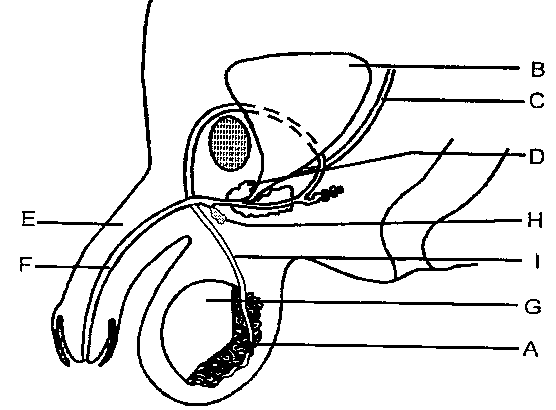
b) State one function for each of the parts labelled D, H, I and F.
b) Draw a longitudinal section of a flower and label the structures that;
i) Perform similar functions with structures F and G in the diagram below.
ii) Helps in pollination
iii) Receive pollen grains
iv) Forms ovules
v) Offers protection to the flower during bud stage
5. Copy the table below in your answer booklet and fill in the gaps. Write only one basic function.
-
Hormone
source
Function
Progesterone
Follicle stimulating hormone
Luteinizing hormone
Oxtocin
Oestrogen
6. Differentiate the following pairs of Biological terminologies
Spermatogenesis and Oogenesis
Still birth and breech birth
Ectopic pregnancy and abortion
Fertilization and implantation
Fraternal twins and identical twins
7. a. What is artificial insemination?
b. Write three (3) advantages of artificial insemination
8. (a) Draw a well labeled diagram of the structure of an ovum
(b) State the function of the following parts in male reproductive system
Seminiferous tubule
Epididymis
Vas deferens
Seminal vesicles
9. (a) Distinguish between sexual and unisexual reproduction (4 points)
(b) Explain the significance of meiosis in relation to reproduction
(c ) List the factors that may affect onset and duration of menstruction cycle in human being (4 point)
10. (a) Briefly explain the following term :-
Incest
Homosexuality
Prostitution
Masturbation
(b) Outline social cultural practices that affect maternal and child care in family and community.
(c ) Give differences between identical and fraternal twins
11. Carefully observe the diagram below which show the developing foetus.
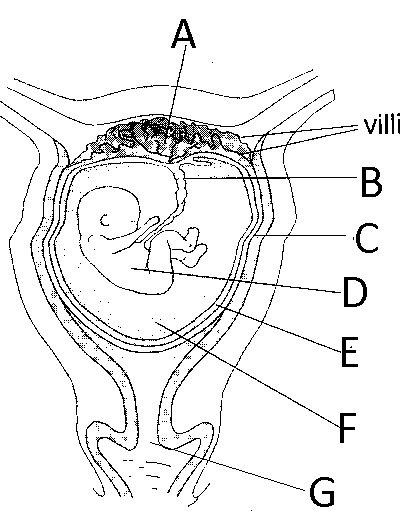
i. Name the stractures labelled A-G
ii. Name the two blood vessels that pass through B
iii. State two (2) main components of blood in each of the vessels passing through structure B
iii. State three functions of the structure labelled
LEARNINGHUBTZ.COM Page

Hub App
 For Call,Sms&WhatsApp: 255769929722 / 255754805256
For Call,Sms&WhatsApp: 255769929722 / 255754805256  MATOKEO YA KIDATO CHA VI 2026
SECONDARY REGIONAL EXAMS
PRIMARY REGIONAL EXAMS
FORM VI NECTA REVIEWS
FORM IV NECTA REVIEWS
FORM II NECTA REVIEWS
STD VII NECTA REVIEWS
STD IV NECTA REVIEWS
SECONDARY EXAMS SERIES
PRIMARY EXAMS SERIES
PRIMARY SUBJECT NOTES
SECONDARY SUBJECT NOTES
SECONDARY TOPICAL EXAMS
SECONDARY TOPICAL QUESTIONS
PRIMARY TOPICAL QUESTIONS
PRACTICAL EXAMS & NOTES
SECONDARY REGIONAL EXAMS
DOWNLOAD SUBJECT NOTES
SCHEMES OF WORK (PRIMARY & SECONDARY)
LESSON PLAN
SECONDARY LOG BOOKS
PRIMARY LOG BOOKS
LITERARY WORKS / UCHAMBUZI VITABU
METHALI ZOTE ZA KISWAHILI
Vitendawili Vya Kiswahili
FORM VI RESULTS 2024
FORM FIVE SELECTION 2024
Matokeo KIDATO CHA II 2024
Matokeo Darasa IV 2024
MATOKEO KIDATO CHA IV 2023
FORM ONE SELECTION 2024
FORM VI RESULTS 2023
Matokeo Darasa IV 2022
MATOKEO YA KIDATO CHA VI 2026
SECONDARY REGIONAL EXAMS
PRIMARY REGIONAL EXAMS
FORM VI NECTA REVIEWS
FORM IV NECTA REVIEWS
FORM II NECTA REVIEWS
STD VII NECTA REVIEWS
STD IV NECTA REVIEWS
SECONDARY EXAMS SERIES
PRIMARY EXAMS SERIES
PRIMARY SUBJECT NOTES
SECONDARY SUBJECT NOTES
SECONDARY TOPICAL EXAMS
SECONDARY TOPICAL QUESTIONS
PRIMARY TOPICAL QUESTIONS
PRACTICAL EXAMS & NOTES
SECONDARY REGIONAL EXAMS
DOWNLOAD SUBJECT NOTES
SCHEMES OF WORK (PRIMARY & SECONDARY)
LESSON PLAN
SECONDARY LOG BOOKS
PRIMARY LOG BOOKS
LITERARY WORKS / UCHAMBUZI VITABU
METHALI ZOTE ZA KISWAHILI
Vitendawili Vya Kiswahili
FORM VI RESULTS 2024
FORM FIVE SELECTION 2024
Matokeo KIDATO CHA II 2024
Matokeo Darasa IV 2024
MATOKEO KIDATO CHA IV 2023
FORM ONE SELECTION 2024
FORM VI RESULTS 2023
Matokeo Darasa IV 2022