THE UNITED REPUBLIC OF TANZANIA, PRIME MINISTR'S OFFICE-RALG
FORM FOUR SEPTEMBER MID–TERM EXAMINATIONS
033/1 BIOLOGY
TIME: 3:00 HOURS — SEPTEMBER, 2026
INSTRUCTIONS
- This paper consists of sections A, B and C with a total of eleven (11) questions.
- Answer all questions in section A and B and any two (2) questions from section C.
- Section A carries sixteen (16) marks, section B carries fifty-four (54) marks and section C carries thirty (30) marks.
- All writing must be in blue or black ink except drawings which must be in pencil.
- All communication devices and any unauthorized materials are not allowed in the examination room.
- Write your Examination Number on every page of your answer sheet(s) provided.
SECTION A: (16 MARKS)
Answer all questions
1. For each of the following items (i) – (x) choose the correct answer among the given alternatives and write its letter besides the item number on the answer sheets provided.
(i) Which of the following parts of germinating seed is an embryonic shoot?
B. Radicle
C. Plumule
D. Epicotyl
E. Cotyledon
(ii) During a practical session Adam picked a plant which had the following characteristics; fibrous root system, non-woody stem, vascular bundles without cambium and the flowers contained six sepals and six petals. As a biologist, what class of a plant picked by Adam belongs?
B. Angiospermorphyta
C. Coniferophyta
D. Monocotyledonae
E. Pteridophyte
(iii) The following are the organs responsible for blood sugar regulations:
B. Kidney and liver
C. Heart and kidney
D. Pancreas and liver
E. Spleen and liver
(iv) After drinking beer, a woman was seen to urinate frequently. What is the relationship between drinking beer and frequent urination?
B. Beer contains alcohol which relaxes the urinary bladder muscles
C. Beer contains alcohol which interferes with the function of Anti-diuretic hormone (ADH)
D. Frequent urination avoids getting drunk
E. Beer transports large volume of water
(v) A man with brown iris eyes married a woman with blue iris eyes, in F1 generation all of their offspring were brown iris eyes. What does this suggest about brown iris colour?
(vi) Which of the following is the site of digestion where both mechanical and chemical digestion occurs?
B. Oesophagus
C. Mouth
D. Small intestine
E. Duodenum
(vii) All of the following are respiratory surfaces EXCEPT:
B. Lung
C. Leaves
D. Gills
E. Heart
(viii) Which of the following is the correct order of events?
B. Fertilization, ovulation, implantation
C. Implantation, fertilization, ovulation
D. Fertilization, implantation, ovulation
E. Ovulation, implantation, fertilization
(ix) Are found in both plant and animal cell?
B. Mitochondria, nucleus and cell wall
C. Cell membrane, cytoplasm and nucleus
D. Chloroplast, nucleus and cytoplasm
E. Vacuole, cell wall and nucleus
(x) Which field of study is not related to biology?
B. Evolution
C. Medicine
D. Forestry
E. Sociology
2. Match the hormone in List A with their corresponding effect in human body in List B by writing the letter of the correct response beside the item number in the answer sheet provided.
| LIST A | LIST B |
|---|---|
|
|
SECTION B: (54 MARKS)
Answer all questions in this section
3.
(a) Plants are able to make their own food through photosynthesis, still the animals benefits much from this process. As a Form Four student explain four benefits of such process to animal.
(b) The small intestine is an important part of alimentary canal that makes maximum absorption of several nutrients, explain five features that make it efficient in performing its role.
4.
(a) Explain how the following theory explains origin of life in the Earth:
i. Special creation theory
ii. Spontaneous generation
iii. Cosmozoan theory
(b) The ancestors of the Modern ducks had no webbed toes and lived on land. In the light of two (2) Lamarck's ideas explain the evolution of these Modern ducks.
5. In multicellular organism the characteristics are carried in the nucleus and are considered to be genetic materials and are explained in genetic studies.
(a) Give four (4) differences between DNA and RNA.
(b) Colour blindness is a sex linked character controlled by a recessive gene located on the X chromosome. Only homozygous females suffer from this condition and it is more common to males. What percentage will the males suffering from colour blindness be if a normal male marries a colour blind female? Show a net crossing.
6. Khalid was making some tea for her mother, accidentally touched the pan while switching off the stove. He pushed away the pan and poured all the tea.
i. What is the name of that response?
ii. What is the name given to the pathway that describes the response in 6 (i) above?
iii. Is there any one significance of the response mentioned in 6 (i) above?
iv. Explain the pathway of an impulse from the sense organ to the effector of Khalid's hand.
7.
(a) Prisca was suffering from diabetes mellitus. When she went for medical treatment she was advised to reduce intake of carbohydrate (glucose) in order to reduce the amount of glucose in the blood stream. What are the hormones involved in blood sugar balance?
(b) For each hormone you have mentioned in 7(a) above state the cell where those hormones are produced.
(c) With help of equation explain the mechanism that takes place when the hormones named above are involved in regulation of glucose.
8. In order the organism to grow well there must be a particular kind of cell division.
(a) Identify and give meaning of the kind of cell division responsible for growth.
(b) State four (4) advantages of the identified type of cell division mentioned in 8(a) above.
SECTION C: (30 MARKS)
Answer two (2) questions from this section
9. Life on the Earth would have been impossible without the presence of bacteria. Justify this statement by giving six (6) points.
10. Endotherms are able to survive in different weather conditions without fluctuation of their body temperature. Explain the mechanism that aid them to withstand cold and hot weather conditions.
11. Describe how pollination is beneficial to the farmers. Give six (6) points.
FORM FOUR BIOLOGY EXAM SERIES 260
FORM FOUR BIOLOGY EXAM SERIES 260
PRESIDENT’S OFFICE, REGIONAL ADMINISTRATION AND LOCAL GOVERNMENT
SECONDARY EXAMINATION SERIES
BIOLOGY FORM FOUR
MID-TERM EXAMS – AUGUST – 2023
TIME: 2:30 HRS
INSTRUCTIONS
SECTION A
- For each of the questions (i) – (x) choose the correct answer from alternatives given
- George has a passion to study bacteria, viruses, Protozoa and other small organisms in future, which branch of Biology is he interested?
- Mycology
- Virology
- Microbiology
- Monera
- Virology
- Identify the number of chromosomes in a dog reproductive cell obtained by form IV students after allowing cells to undergo meiosis process
- 78 before meiosis, 29 after meiosis
- 39 before meiosis 49 after meiosis
- 78 before meiosis 79 after meiosis
- 76 before meiosis 39 after meiosis
- 76 before meiosis 152 after meiosis
- Which part of human alimentary canal performs the same function as gizzard in chicken
- The appendix
- The ileum
- The gall bladder
- Stomach
- Salivary glands
- Which cell structure below is sight for production of energy in plants
- Ribosome’s
- Mitochondria
- Chloroplast
- Nucleus
- Vacuole
- Moses was operated and Part of his reproductive system removed. He could not produce sperms. Which part was removed
- Sperm duct
- Epididymis
- Scrotum
- Somniferous Tubular
- Vas deferens
- The part of mammalian eye that controls shape and curvature of lens is?
- Iris
- Ciliary
- Conjunctiva
- Suspensory ligament
- Pupil
- Identify actions which regulate temperature in mammals
- Sweating, shivering, swimming, urinating
- Shivering , vasodilatation, sweating, vasoconstriction
- Conduction, radiation, convection, swimming
- Vasodilation, swimming, sweating and Bathing
- Swimming, conduction, convection and radiation
- The part of microscope that is responsible for viewing finer details in a specimen is
- Condenser
- Diaphragm
- Fine adjustment knob
- Objective lens
- Course adjustment knob
- If a plants cell is placed in hypotonic solution, it experience a biological condition called;
- Haemolysis
- Turgidity
- Crenation
- Plasmolysis
- Turgor pressure
- Form four students were presented with two cells. Cell A(plant cell) and cell B(animal cell). Which feature can be used to differentiate cell A from cell B?
- Presence of mitochondrion
- Presence of vacuole
- Presence of cell wall
- Presence of cell membrane
- Presence of cytoplasm.
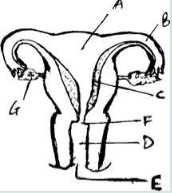
- Match part of female reproductive system in List B with its function in List A and write the correct answer on spaces provided.
| LIST A | LIST B |
|
|
SECTION B (54 Marks)
Answer all questions
- Figure below shows a plant root study the diagram and answer questions that follow.
(a)
- Name group of plant represented by diagram in figure 1.
- Give any two examples of plants which can be found in group of plants mentioned in (a) above
- Name the Organism which inhabit the swelling of the roots
- What is the name of the relationship existing between the plant and the organism mentioned in (a)(i) above
(b)Name the bacterium which does the Nitrogen fixation cycle
(c)Suppose your biology teacher organizes a study tour to Manyara National Park During your visit, You observe the following Organism, vulture antelope, shrubs, cheater, and wildebeest. As a form four student draw a diagram that represents the food web and two food chains from these organisms.
- A bread was left on a cupboard, after 3 days white things were seen with club like structures at the top. As a student
- Identify the organism immersed on the bread
- Name the kingdom and phylum of the Organisms.
(b)Mention any three (3) distinctive features of the kingdom to which mushroom belong
- (a)Explain in one sentence why the following feature occur to these organisms
- Streamlined body of birds
- Ciliated trachea of human
- Needle-like leaves of plants found in desert
- Coiled and elongated ileum in humans
(b)An engineer needs to approve a building to be used as biology laboratory
- What is biology laboratory
- List 4 (four) qualities which he/she must consider in order for that building to be considered as good biology laboratory
- (a)Give the hormone responsible for each of the following biological processes
- Development of male sexual characteristics
- Development of female sexual characteristic
- prepares the body for fight or flight response
- Raised blood sugar level
- Initiate labour pain
(b)Nervous coordination differs from hormonal coordination. Explain in four (4) points
- After nine months of pregnancy Ummu Ayman gave birth to male babies who looked alike in almost all aspect and Umma Atwiya gave birth to a boy and girl who did not resemble too much.
- What name is given to this type of pregnancy
- What are the causes of this type of pregnancy
- In which ways do the ways do the Ummu Ayman kids different from Alwiya’s kids?
- (a)The diagram below illustrates a specialized cell obtained from a certain tissue
- Name the cell
- State two ways in which the cell is structurally adapted to its function
(b) State the role of each of the following in the mammalian respiratory system
- Mucus
- Cartilage rings
- Epiglottis
SECTION C (30 Marks)
Answer only two questions
- Six year old boy was diagnosed with a tropical protozoan disease that is characterized by high fever frontal headache, joint pain and loss of appetite
Write an essay about the disease the boy is suffering from showing
- Causes transmission mode
- Effects
- Prevention (any 4 points)
- (a)A female human being was found to have an extra sex chromosome in her cells
- Give the total number of chromosomes in the female individual cells
- Explain the possible cause of this condition
- State physical characteristics observed in the female individual with such a condition
(b)Explain why fossil records as evidence of organic evolution are usually incomplete
(c)Name the evidence of similar amino acid molecules in a range of Organisms
- Explain the various ways in which seeds and fruits are adapted to dispersal
FORM FOUR BIOLOGY EXAM SERIES 162
FORM FOUR BIOLOGY EXAM SERIES 162
PRESIDENT’S OFFICE, REGIONAL ADMINISTRATION
AND LOCAL GOVERNMENT
SECONDARY EXAMINATION SERIES
BIOLOGY FORM FOUR
MID-TERM EXAMS – AUGUST – 2023
TIME: 2:30 HRS
INSTRUCTIONS
SECTION A
- For each of the questions (i) – (x) choose the correct answer from alternatives given
- George has a passion to study bacteria, viruses, Protozoa and other small organisms in future, which branch of Biology is he interested?
- Mycology
- Virology
- Microbiology
- Monera
- Virology
- Identify the number of chromosomes in a dog reproductive cell obtained by form IV students after allowing cells to undergo meiosis process
- 78 before meiosis, 29 after meiosis
- 39 before meiosis 49 after meiosis
- 78 before meiosis 79 after meiosis
- 76 before meiosis 39 after meiosis
- 76 before meiosis 152 after meiosis
- Which part of human alimentary canal performs the same function as gizzard in chicken
- The appendix
- The ileum
- The gall bladder
- Stomach
- Salivary glands
- Which cell structure below is sight for production of energy in plants
- Ribosome’s
- Mitochondria
- Chloroplast
- Nucleus
- Vacuole
- Moses was operated and Part of his reproductive system removed. He could not produce sperms. Which part was removed
- Sperm duct
- Epididymis
- Scrotum
- Somniferous Tubular
- Vas deferens
- The part of mammalian eye that controls shape and curvature of lens is?
- Iris
- Ciliary
- Conjunctiva
- Suspensory ligament
- Pupil
- Identify actions which regulate temperature in mammals
- Sweating, shivering, swimming, urinating
- Shivering , vasodilatation, sweating, vasoconstriction
- Conduction, radiation, convection, swimming
- Vasodilation, swimming, sweating and Bathing
- Swimming, conduction, convection and radiation
- The part of microscope that is responsible for viewing finer details in a specimen is
- Condenser
- Diaphragm
- Fine adjustment knob
- Objective lens
- Course adjustment knob
- If a plants cell is placed in hypotonic solution, it experience a biological condition called;
- Haemolysis
- Turgidity
- Crenation
- Plasmolysis
- Turgor pressure
- Form four students were presented with two cells. Cell A(plant cell) and cell B(animal cell). Which feature can be used to differentiate cell A from cell B?
- Presence of mitochondrion
- Presence of vacuole
- Presence of cell wall
- Presence of cell membrane
- Presence of cytoplasm.
- Match part of female reproductive system in List B with its function in List A and write the correct answer on spaces provided.
| LIST A | LIST B |
|
|
SECTION B (54 Marks)
Answer all questions
- Figure below shows a plant root study the diagram and answer questions that follow.
(a)
- Name group of plant represented by diagram in figure 1.
- Give any two examples of plants which can be found in group of plants mentioned in (a) above
- Name the Organism which inhabit the swelling of the roots
- What is the name of the relationship existing between the plant and the organism mentioned in (a)(i) above
(b)Name the bacterium which does the Nitrogen fixation cycle
(c)Suppose your biology teacher organizes a study tour to Manyara National Park During your visit, You observe the following Organism, vulture antelope, shrubs, cheater, and wildebeest. As a form four student draw a diagram that represents the food web and two food chains from these organisms.
- A bread was left on a cupboard, after 3 days white things were seen with club like structures at the top. As a student
- Identify the organism immersed on the bread
- Name the kingdom and phylum of the Organisms.
(b)Mention any three (3) distinctive features of the kingdom to which mushroom belong
- (a)Explain in one sentence why the following feature occur to these organisms
- Streamlined body of birds
- Ciliated trachea of human
- Needle-like leaves of plants found in desert
- Coiled and elongated ileum in humans
(b)An engineer needs to approve a building to be used as biology laboratory
- What is biology laboratory
- List 4 (four) qualities which he/she must consider in order for that building to be considered as good biology laboratory
- (a)Give the hormone responsible for each of the following biological processes
- Development of male sexual characteristics
- Development of female sexual characteristic
- prepares the body for fight or flight response
- Raised blood sugar level
- Initiate labour pain
(b)Nervous coordination differs from hormonal coordination. Explain in four (4) points
- After nine months of pregnancy Ummu Ayman gave birth to male babies who looked alike in almost all aspect and Umma Atwiya gave birth to a boy and girl who did not resemble too much.
- What name is given to this type of pregnancy
- What are the causes of this type of pregnancy
- In which ways do the ways do the Ummu Ayman kids different from Alwiya’s kids?
- (a)The diagram below illustrates a specialized cell obtained from a certain tissue
- Name the cell
- State two ways in which the cell is structurally adapted to its function
(b) State the role of each of the following in the mammalian respiratory system
- Mucus
- Cartilage rings
- Epiglottis
SECTION C (30 Marks)
Answer only two questions
- Six year old boy was diagnosed with a tropical protozoan disease that is characterized by high fever frontal headache, joint pain and loss of appetite
Write an essay about the disease the boy is suffering from showing
- Causes transmission mode
- Effects
- Prevention (any 4 points)
- (a)A female human being was found to have an extra sex chromosome in her cells
- Give the total number of chromosomes in the female individual cells
- Explain the possible cause of this condition
- State physical characteristics observed in the female individual with such a condition
(b)Explain why fossil records as evidence of organic evolution are usually incomplete
(c)Name the evidence of similar amino acid molecules in a range of Organisms
- Explain the various ways in which seeds and fruits are adapted to dispersal
FORM FOUR BIOLOGY EXAM SERIES 161
FORM FOUR BIOLOGY EXAM SERIES 161
THE PRESIDENT’S OFFICE MINISTRY OF EDUCATION, REGIONAL ADMINISTRATION AND LOCAL GOVERNMENT
COMPETENCY BASED SECONDARY EXAMINATION SERIES
BIOLOGY
FORM FOUR- SEPT 2022
BIOLOGY 01
CODE 033/1
INSTRUCTIONS
- This paper consists of section A, B and C with a total of fifteen (15) questions.
- Answer ALL questions in sections A and B and two (2) questions from section C of which question thirteen (13) is compulsory with 15 Marks.
- Section A carries fifteen (15) marks, section B carries(60) Marks and section C carries(25) Marks
- All writings should be in blue or black pen except for diagrams that should be drawn in pencil.
- Cellular phones and any unauthorized materials are NOT allowed in the examination room.
- Write your examination number on every page of your answer sheet.
| FOR EXAMINER’S USE ONLY | ||
| QUESTION NUMBERS | SCORES | INITIALS FOR EXAMINER’S |
| 1 |
|
|
| 2 |
|
|
| 3 |
|
|
| 4 |
|
|
| 5 |
|
|
| 6 |
|
|
| 7 |
|
|
| 8 |
|
|
| 9 |
|
|
| 10 |
|
|
| 11 |
|
|
| 12 |
|
|
| 13 |
|
|
| 14 |
|
|
| 15 |
|
|
| TOTAL SCORES |
|
|
SECTION A: (15 MARKS)
- For each of the items (i) – (x), choose the correct answer from among the given alternatives and write its letter beside the item number in he answers booklet provided.
- The taxonomy category of organisms belonging to the same class but not the same family is___________
- Kingdom
- order
- phylum
- genus
- Specie
- A joint which allows movement in one direction is called:
- Gliding joint
- Ligament
- Pivot joint
- Ball and socket joint
- Hinge joint
- Apart that anchor the mushroom and also enable it to absorb nutrients:
- Hyphae
- Pileus
- Gills
- Stalk
- Body parts
- Bacteria in the caecum of ruminants digest cellulose. This is an example of______
- Mutualism
- Saprophytism
- Parasitism
- Commensalism
- A and D above are correct
- Which substance in tobacco combine with hemoglobin to prevent hemoglobin from carrying oxygen.
- Tannins
- Cannabis
- Nicotine
- Carbon monoxide
- Carbon dioxide
- Enzymes that hydrolyze starch to maltose
- Rennin
- Amylase
- Peptidase
- Sucrose
- lipase
- Which part of the seed grows into a root system of a plant
- Micropyle
- Plumule
- Radical
- Hilum
- Cotyledon
- A term which best describes a condition of a plant that lost too much water is
- Crenation
- Plasmolysis
- Hemolysis
- Osmosis
- Turgidity
- Why is it advised to build an incinerator in every hospital and health centers?
- For disposing gaseous waste
- For collection of waste
- For disposing liquid waste
- For burning hazardous waste
- For storage of waste
- HIV and AIDS has spread all over the world. This implies that it is
- Transmittable
- Pandemic
- Endemic
- Sporadic
- Epidemic
- Match the response in LIST B with the phrase in LIST A by writing the letter of the correct response besides the item number of LIST A in your answer sheet.
| List A | List B |
|
|
SECTION B: (60 MARKS)
Answer all questions in this section
- (a) (i) Name three types of muscles found in mammals
(ii) Which of the muscle named in a (i) is a voluntary muscle?
(b) Yesterday in the evening Hanna’s muscles became hard, knotted and she experienced a lot of pains. What do you think was a cause and give solutions?
- (a) With examples differentiate between pandemic and epidemic diseases.
(b) How can the body immunity be affected?
- (a)Explain effectively why pituitary gland is said to be the master gland?
(b)How does the endocrine system differ from the exocrine system? Give vivid explanation
(c) What will happen if:
- Semi-circular canal is damaged
- Under-secretion of thyroxin hormone at age of 3 years.
- (a) (i) briefly explain why do biologists prefer to use light microscopes in the laboratory rather than using normal eyes.
(ii) State three (03) factors that determine the volume, color, odor, of urine and frequency
of urination.
(b)The effect of constructing a laboratory aims at rising students’ performance in science subjects:
- Define biology laboratory
- Name four specimen expected to be found in the laboratory.
- Study the figure below that illustrates a feeding relationship in an ecosystem. The arrow means “eaten by” then answer the questions below

- i. What is the name given to the feeding relation in the figure above?
ii. Which important group of organisms should be included in the diagram to make the ecosystem balanced?
iii. Of what importance is the missing group named in a (ii) above to the feeding relationship?
- Giving reasons identify one organism in the figure which is
- First trophic level
- Prey and Predator
- A secondary consumer
- (a) What do you understand by the following terms
- Evolution
- Vestigial organs with examples
- State any three (03) theories which explain the origin of life.
- The diagram below shows the development of follicles at different stages inside the ovary

- Name the structure labeled A, B and C.
- (i) What kind of hormone is secreted by the structure labeled A
(ii) What roles the hormone produced in A play in human reproduction
(iii) State the biological term used to describe the release of the structure labelled C in the funnel of oviduct.
(iv) In which specific organ does this process take place?
- (a)Mr. Lesema is homozygous tall; he married a female who is homozygous dwarf, if the gene for tallness was dominant over dwarfness. Use Mendelian crosses to determine the phenotypic ratio in the first filial generation.
(b)Give the meaning of the following terms
i. Somatic cells
ii. Continuous variation
iii. Turner syndrome
- (a)Define the term osmoregulation.
(b)Briefly explain the mechanism of regulating sugar level in the blood.
- (a) i. What are three adaptations of White blood cells for their function?
ii. What cause and how agglutination occurs?
(b) Analyze any three adaptations of the muscles found on the Heart
SECTION C: (25 Marks)
Answer two (02) question in this section number 13 is compulsory
13. Explain four advantages and three disadvantages of blood transfusion then provide at least two precautions to taken during blood transfusion.(15 marks)
14. Explain how mammals regulate their internal body temperature in response to external environment changes (10 Marks).
15. Evaluate any four birth control methods (10 Marks)
FORM FOUR BIOLOGY EXAM SERIES 112
FORM FOUR BIOLOGY EXAM SERIES 112
MINISTRY OF EDUCATION, REGIONAL ADMINISTRATION AND LOCAL GOVERNMENT
COMPETENCY BASED SECONDARY EXAMINATION SERIES
BIOLOGY 1 MID TERM EXAMINATION
FORM FOUR-AUG/SEPT 2021
Time: 3Hours
Instructions.
- This paper consists of section A, B and C with a total of 15 questions.
- Answer all questions in section A and B and TWO (2) question from section C in which question 13 compulsory.
- All writing should be in blue or black pen, except for diagrams that must be drawn in pencil.
- Cellular phones and any unauthorized materials are not allowed in the examination room.
- Write your number on every page of your answer booklet.
SECTION A (20 Marks)
Answer All questions in this section.
1. For each of the items (i)-(x), choose the correct answer from among the given alternatives and write its letter beside the item number in the answer booklet provided.
(vii) A biologist discovered a new cell in a culture. The new cell had a distinct cell wall but it did not have a definite nucleus. The cell is most likely to be:
- Fungi
- Prokaryote
- Protozoa
- Virus
- Eukaryote
(iv) A human ovary produces ova and the following hormones:
- Oestrogen and testosterone
- Progesterone and testosterone
- Follicle stimulating hormone (F.S.H) and progesterone.
- Oestrogen and progesterone
- F.S.H and Oestrogen.
(ii) Green plants are known as producers because they:
- produce chlorophyll in chloroplasts
- produce green leaves
- contain fruits and seeds
- grow in fertile soil
- make food from simple stibstances
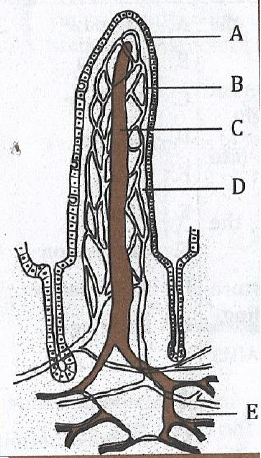
(vii) Figure 2 shows a section of a villus.
Which part is a lymphatic vessel?
|
|
(vi) Which of the following prevents surfaces of the articulating bones from being worn out by friction?
- Capsular ligament
- Synovial membrane
- Articular cartilage
- Tendon
- Synovial capsule
(ii)Which one of the following is a group of animal tissues?
- Muscles, blood, nerve and epithelia
- Eye, muscles, skin and blood
- Cardiac muscles, skin, liver and blood
- Blood, muscles, skin and kidney
- Liver, pancreas, lymph and ear
(iii)Diabetes mellitus is associated with:
- Too much insulin in the blood
- Too much glucose in the lymph
- High glycogen level in the blood
- Under secretion of insulin in the blood
- Too little glucagon in the blood
(ix) Which hormones produced by the pituitary gland promote ovulation?
- Follicle stimulating hormone (FSH) and lutenizing hormone (LH)
- Lutenizing hormone (LH) and progesterone
- Oestrogen and progesterone
- Progesterone and follicle stimulating hormone (FSH)
- Prolactin and progesterone
(iii) Which substance in tobacco combines with haemoglobin to prevent the haemoglobin from carrying oxygen?
- Carbon dioxide
- Carbon monoxide
- Nicotine
- Tar
- Cellulose fibre
(vii) During the school race Mary experienced an increased rate in breathing.
This is because breathing rate supplies extra:
- energy required by the active muscle.
- oxygen required by the active muscle.
- heat required by the active muscle.
- enzymes required by the active muscles for respiration.
- Work required by the muscles for faster running.
2. Match the functions of the parts of microscope in List A with their corresponding parts of microscope in List B by writing the letter of the correct response beside the item number in the booklet provided.
2. Match the responses in List B with the phrases in List A by writing the letter of the correct response from List B beside the item number of List A in your answer booklet. Each choice in column B may be used once, more than once or not at all.
| LIST A | LIST B |
|
|
SECTION B (60 Marks)
Answer all questions in this section.
3. (a) (i) List the five kingdoms into which organisms are placed.
(ii) List the distinctive features of members of the kingdom to which a malaria vector belongs.
(b) (i) Identify by using common name, two types of flatworm found in the alimentary canal of a living organism.
(ii) To which kingdom does organism in (b)(i) belong?
4.(a) The following are methods of controlling diseases. Mention one disease that can be controlled by each method.
(i) Clean water supplies
(ii) Hygienic disposal of refuse and sewage
(iii)Eradication of mosquitoes
(iv) Vaccination
(b) What are the functions of blood in man?
5. (a) Mention four (4) ways of helping someone who has been bitten by a snake.
(b)Identify one (1) important thing that should never be given to a victim of a snake bite. Give reasons.
6. The diagram below represents some gaseous exchange structures in humans.
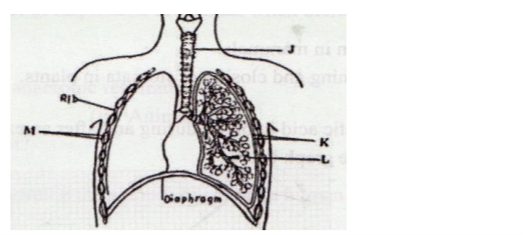
(a) Name the structures labeled K, L, and M . (3 marks)
(b) How the structure labeled J is suited to its function?
(c) Name the process by which inhaled air moves from the structure labeled L into blood capillaries
(d) Give the scientific name of the organism that causes tuberculosis in humans
7. Using a relevant example in each case, describe simple and conditional reflex actions.
8. The diagram below shows an experimental set up to investigate a certain physiological process in plants.
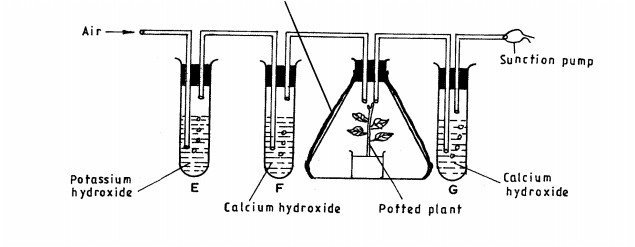
(a) State the aim of the experiment. (1 mark)
(b) State the role of the following in the experiment:
(i) potassium hydroxide; (1 mark)
(ii)Aluminium foil.(1 mark)
(c) Account for the expected colour change in tube F.(2 marks)
9. (a) Name two types of involuntary muscles in mammals. (2 marks)
(b) State the location of each of the muscles named in (a) above. (2 marks)
10. State four (4) differences between nervous communication and endocrine communication
11. (a) Explain the following Mendelian traits and give their effect to human beings.
(i)Haemophilia
(ii)Sickle anaemia
(b) In a certain species, two homozygous individuals mated and resulting offspring in Fl was heterozygous with the same phenotype. However in the second filial generation (F2) a new heterozygous phenotype was obtained which looked different from the parents in F1 With the help of genetic diagrams, explain how individuals with different phenotype in F2 were obtained.
12.
(a) Name parts of the alimentary canal where:
(i)Digestion of starch takes place
(ii)Absorption of the end products of digestion takes place
(b)State one major function of each of the following cells and describe one way in which thCcell is adapted to carry out its function.
(i)Red blood cell:
Function . . . . . . . .
Adaptation ............
(ii)Root hair cell:
Function . . . . . . . .
Adaptation ...........
SECTION C (25 Marks)
Answer two (2) questions from this section. Question 13 is compulsory.
13. . Explain the various ways in which seeds and fruits are adapted to dispersal.
14.Some chemical reactions take place inside the living systems. Some of the products given out are harmful if allowed to accumulate; these are known as excretory products. Explain the excretory products in human beings based on the excretory organ involved in each product, where it is produced and its effects to the human body.
15. (a) Food preservation is very important in human life. Discuss its importance under the following headings:(a) Need for preservation.
(b) Local food preservation methods and their biological effects.
FORM FOUR BIOLOGY EXAM SERIES 63
FORM FOUR BIOLOGY EXAM SERIES 63
THE PRESIDENTS OFFICE
MINISTRY OF REGIONAL GOVERNMENT AND LOCAL GOVERNMENT
PRE-NATIONAL EXAMINATION SERIES-1
BIOLOGY FORM-4
2020
TIME: 3:00 HRS
Instructions
- This paper consists of sections A, B and C with a total of fifteen (15) questions.
- Answer all the questions in sections A and B and two (2) questions from section C of which question 13 is compulsory.
- All writing should be in blue or black pen, except for diagrams that must be drawn in pencil.
- Cellular phones and any unauthorised materials are not allowed in the examination room.
- Write your Examination Number on every page of your answer booklet(s).
SECTION A (15 Marks)
Answer all questions in this section.
1 For each of the items (i) - (x), choose the correct answer from among the given alternatives and write its letter beside the item number in the answer booklet provided.
(i) Why is it advised to build an incinerator in every hospital and health centre?
- for collecting wastes.
- for disposing gaseous wastes.
- for disposing liquid wastes.
- for burning hazardous wastes.
- for disposing plastic wastes.
(ii) flow many gametes are produced from one cell during meiosis?
- Eight
- Two
- Four
- Six
- Ten.
(iii) Which of the following is the excretory organ in human?
- Mouth
- Kidney
- Pancreas
- Stomach
- Anus.
(iv) Which of the following hormones stimulates seed germination in plants?
- Gibberellins
- Auxin
- Cytokinins
- Abscisic acid
- Ethene.
(v) A joint which allows rotation in all planes is called
- suture
- ball and socket
- pivot
- ligament
- hinge.
(vi) A phylum consisting of species with jointed appendages and exoskeleton is known as
- Chordata
- Anelida
- Arthropoda
- Platyhelminthesis
- Nematoda.
(vii) Which part of the flower receives pollen grain during pollination?
- Petal
- Stigma
- Stamen
- Style
- Ovary.
(viii) A rapid growth in plants is mainly taking place in
- leaves
- cambium
- roots
- shoots and root tips
- stem.
(ix) Which of the following is NOT a component of First Aid Kit?
- Razor blade
- Panadol
- Bandage
- Soap
- Microscope.
(x) A part of an onion bulb which is important for vegetative propagation is
- scale leaves
- foliage leaves
- terminal buds
- roots
- stem.
2. Match the phrases in List A with the responses in List B by writing the letter of the correct response from List B beside the item number of List A in your answer booklet.
| LIST A | LIST B |
|
|
SECTION B (60 Marks)
Answer all questions in this section.
3. (a) Give the meaning the following terms as used iri Biology:
- Blood transfusion.
- Blood compatibility.
(b) (i) State two advantages of blood transfusion.
(ii) Outline four precautions to be taken during blood transfusion
4. (a) List any four macro-elements in plant nutrition.
(b) Explain the causes of any three common disorders and diseases of the human digestive system.
5. (a) Name three type of muscles found in mammals.
(b) Briefly explain how muscles are adapted to their role. Give three points.
6. (a) State three basic principles of waste disposal.
(b) Why poor waste disposal at home is said to cause adverse effects?
7.(a) Give the meaning of the following terms:
- Vegetative propagation.
- Gamete.
(b) Explain the merits and demerits of asexual reproduction in plants.
8. (a) What do you understand by the term “First Aid”?
(b) State how you would render First Aid to a person who has been shocked by electric current.
9. (a) Define the terms “digestion” and “feeding” as used in Biology.
(b) Explain why during digestion the food is:
- Alkaline when in the mouth.
- Acidic when in the stomach.
- Alkaline when in the ileum.
- (a) Define the term “osmoregulation”.
(b) Briefly explain the mechanisms of regulating sugar level in the blood.
11. Outline merits and demerits of Lamercks theory of evolution.
12.. In the experiment conducted on single factor inheritance, individuals which were male homozygous tall married a female who was homozygous dwarf. The gene for tall was dominant over dwarf. Use the crosses to find out the possibility of the phenotypic results and the ratio in the first filial generation.
SECTION C (25 Marks)
Answer two (2) questions from this section. Question 13 is a compulsory.
13.(a) Explain the process of fertilization in flowering plants.
14. With the aid of illustrations, discuss the stages of mitosis.
15. Elaborate the causes of drug abuse to young people and advise the Tanzanian Government on the ways of combating drug abuse in the country.
FORM FOUR BIOLOGY EXAM SERIES 35
FORM FOUR BIOLOGY EXAM SERIES 35

DOWNLOAD LEARNING HUB APP NOW

SORRY, YOU CAN'T VIEW THIS MARKING SCHEME PLEASE DOWNLOAD LEARNING HUB APP FROM PLAYSTORE TO GET FULL ACCESS TO ALL MARKING SCHEME!!
Click Here To Download Learning Hub Tanzania App
SAMAHANI, HUWEZI KUFUNGUA MAJIBU YA MTIHANI, TAFADHALI PAKUA APP YA LEARNING HUB TANZANIA ILI KUWEZA KUFUNGUA MAJIBU YA MITIHANI KATIKA TOVUTI HII!!
Bofya Hapa Kupakua App Ya Learning Hub Tanzania
Hub App
 For Call,Sms&WhatsApp: 255769929722 / 255754805256
For Call,Sms&WhatsApp: 255769929722 / 255754805256  MATOKEO YA KIDATO CHA VI 2026
SECONDARY REGIONAL EXAMS
PRIMARY REGIONAL EXAMS
FORM VI NECTA REVIEWS
FORM IV NECTA REVIEWS
FORM II NECTA REVIEWS
STD VII NECTA REVIEWS
STD IV NECTA REVIEWS
SECONDARY EXAMS SERIES
PRIMARY EXAMS SERIES
PRIMARY SUBJECT NOTES
SECONDARY SUBJECT NOTES
SECONDARY TOPICAL EXAMS
SECONDARY TOPICAL QUESTIONS
PRIMARY TOPICAL QUESTIONS
PRACTICAL EXAMS & NOTES
SECONDARY REGIONAL EXAMS
DOWNLOAD SUBJECT NOTES
SCHEMES OF WORK (PRIMARY & SECONDARY)
LESSON PLAN
SECONDARY LOG BOOKS
PRIMARY LOG BOOKS
LITERARY WORKS / UCHAMBUZI VITABU
METHALI ZOTE ZA KISWAHILI
Vitendawili Vya Kiswahili
FORM VI RESULTS 2024
FORM FIVE SELECTION 2024
Matokeo KIDATO CHA II 2024
Matokeo Darasa IV 2024
MATOKEO KIDATO CHA IV 2023
FORM ONE SELECTION 2024
FORM VI RESULTS 2023
Matokeo Darasa IV 2022
MATOKEO YA KIDATO CHA VI 2026
SECONDARY REGIONAL EXAMS
PRIMARY REGIONAL EXAMS
FORM VI NECTA REVIEWS
FORM IV NECTA REVIEWS
FORM II NECTA REVIEWS
STD VII NECTA REVIEWS
STD IV NECTA REVIEWS
SECONDARY EXAMS SERIES
PRIMARY EXAMS SERIES
PRIMARY SUBJECT NOTES
SECONDARY SUBJECT NOTES
SECONDARY TOPICAL EXAMS
SECONDARY TOPICAL QUESTIONS
PRIMARY TOPICAL QUESTIONS
PRACTICAL EXAMS & NOTES
SECONDARY REGIONAL EXAMS
DOWNLOAD SUBJECT NOTES
SCHEMES OF WORK (PRIMARY & SECONDARY)
LESSON PLAN
SECONDARY LOG BOOKS
PRIMARY LOG BOOKS
LITERARY WORKS / UCHAMBUZI VITABU
METHALI ZOTE ZA KISWAHILI
Vitendawili Vya Kiswahili
FORM VI RESULTS 2024
FORM FIVE SELECTION 2024
Matokeo KIDATO CHA II 2024
Matokeo Darasa IV 2024
MATOKEO KIDATO CHA IV 2023
FORM ONE SELECTION 2024
FORM VI RESULTS 2023
Matokeo Darasa IV 2022