THE UNITED REPUBLIC OF TANZANIA NATIONAL EXAMINATIONS COUNCIL
CERTIFICATE OF SECONDARY EDUCATION EXAMINATION
032/1 CHEMISTRY 1
(For Both School and Private Candidates)
Time: 3 Hours Tuesday, October 11, 2005 p.m.
Instructions
This paper consists of sections A, B and C.
Answer all questions in sections A and B and two (2) questions from section C.
Electronic calculators are not allowed in the examination room.
Cellular phones are not allowed in the examination room.
Write your Examination Number on every page of your answer booklet(s).
The following constants may be used:
Atomic masses: H = 1; C = 12; O = 16; Cu = 64; Ca = 40; Na = 23; S = 32; Cl = 35.5; Fe = 56; N = 14; K = 39. Avogadro’s Number = 6.02 × 10²³. GMV at s.t.p. = 22.4 dm3. 1 Faraday = 96500 coulombs. 1 litre = 1 dm3 = 1000 cm3
SECTION A (20 marks)
Answer all questions in this section.
1. For each of the items (i) - (x) choose the correct answer from among the given alternatives and write its letter beside the item number.
(i) Sodium metal is kept in oil because it
sinks in oil but floats in water
reacts vigorously with water
is very alkaline
forms a protective coat of sodium oxide with oil
forms a protective coat of sodium oxide with water
Choose Answer :
(ii) A gas burned in air forms carbon dioxide and water only. From this experiment the gas is likely to be
hydrogen
carbon monoxide
ethane
nitrogen
ozone
Choose Answer :
(iii) The molarity of a solution containing 26.5 g of anhydrous sodium carbonate in 5 dm3 of the solution is _____ M.
0.05
0.25
1.25
3.50
0.025
Choose Answer :
(iv) It was found that 32.7 g of zinc metal displaces 108 g of silver metal from an aqueous solution of silver nitrate. The correct equation for this reaction is
Zn2+(aq) + Ag(s) → Ag+(aq) + Zn(s)
Zn(s) + Ag+(aq) → Ag(s) + Zn2+(aq)
Zn2+(aq) + 2Ag+(aq) → 2Ag(s) + Zn2+(aq)
Zn2+(aq) + 2Ag+(aq) → 2Ag+(aq) + Zn(s)
Zn(s) + 2Ag+(aq) → Zn2+(aq) + 2Ag(s)
Choose Answer :
(v) The pair of elements which is most likely to form a covalent bond when reacted together is
sodium and iodine
magnesium and oxygen
aluminium and oxygen
carbon and chlorine
calcium and carbon
Choose Answer :
(vi) The method of collecting hydrogen chloride gas in a class experiment is known as
downward displacement of water
downward displacement of air
upward displacement of air
fountain
condensation
Choose Answer :
(vii) Sea water contains various salts, which salt is present in the greatest proportion?
magnesium chloride
calcium sulphate
potassium chloride
sodium chloride
magnesium sulphate
Choose Answer :
(viii) When dilute solutions of calcium chloride and sodium carbonate are mixed,
a white precipitate of sodium chloride is formed
carbon dioxide is evolved
a mixture of precipitates of sodium chloride and calcium carbonate is formed
a white precipitate of calcium carbonate is formed
a colourless solution of calcium carbonate and sodium chloride is formed
Choose Answer :
(ix) The atomic number of elements chlorine, argon and potassium are 17, 18 and 19 respectively. Which statement best describes the three elements? These elements
have the same number of protons
have the same atomic mass
occur in the same period
have the same number of electrons
have octet stable electronic configuration
Choose Answer :
(x) Three test tubes of the same volume separately contain nitrogen dioxide (NO2), hydrogen (H2) and carbon dioxide (CO2) gases at room temperature and pressure. Then, there
is the same number of atoms in each test tube
is the same number of molecules in each test tube
are more molecules of hydrogen gas than nitrogen dioxide and carbon dioxide molecules
is a 3 : 4 : 2 ratio for the number of molecules of carbon dioxide to nitrogen dioxide to hydrogen respectively
is a 2 : 4 : 3 ratio of the number of molecules of carbon dioxide to nitrogen dioxide to hydrogen respectively
Choose Answer :
2. Match the terms in List A with the responses in List B by writing the letter of the correct response beside the item number.
List A
List B
Methane
Nitrogen
Zinc
Detergent
Anion
Amphoteric oxide
Isotopes
Soap
Isomers
Ammonia
Crystallizes
Ethyl alcohol
Alkaline gas
Sublimes
AlCl3
4018X and 3918Y
Diamond and graphite
Rust
A gas present in natural gas
Used to coat iron metal
Turns lime water milky
An acidic gas
Compounds with the same molecular formula but different structural formula
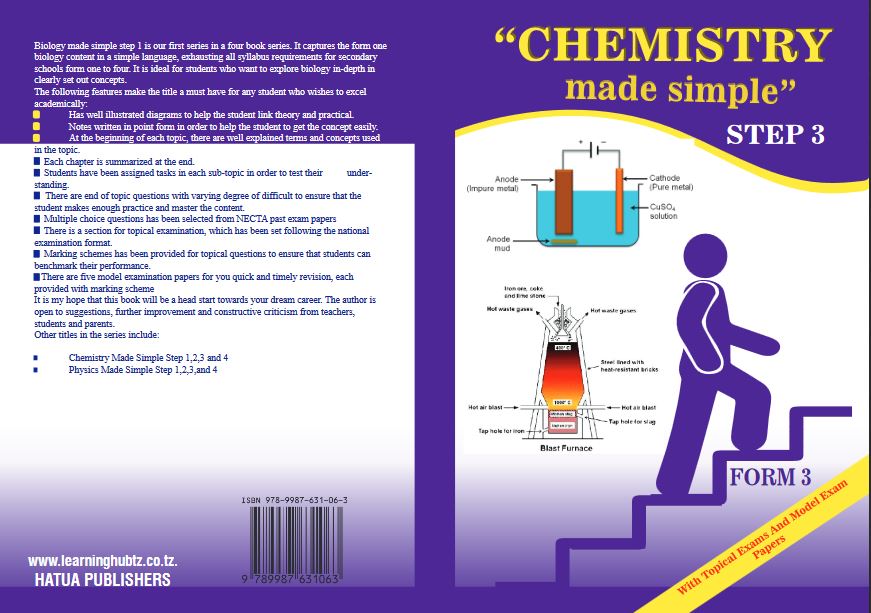
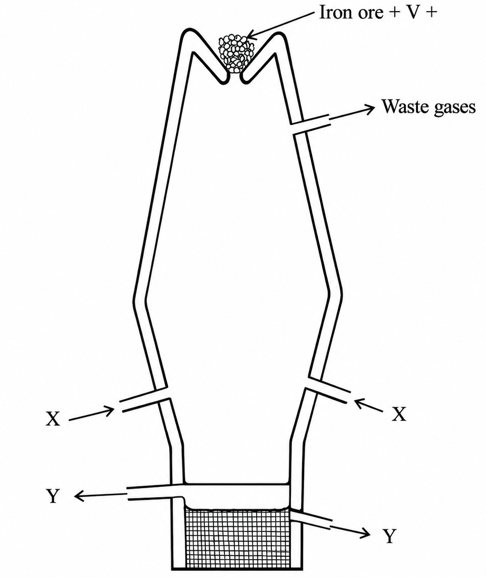
9. A blast furnace is used to convert iron ore, Fe2O3 into iron metal. The following is a diagram of the blast furnace used for the extraction of iron.
(a) Write down the names of
(i) substances represented by materials V, W and X.
(ii) products Y and Z.
(b)
(i) Write a balanced chemical equation for the reaction between the iron ore, Fe2O3 and carbon monoxide.
(ii) What is the function of carbon monoxide in its reaction with Fe2O3? (2½ marks)
(d) If 80 kg of iron ore, Fe2O3 allowed to react with carbon monoxide during the extraction process, how many kilograms of iron (Fe) would be obtained? (04 marks)
10. (a) What do you understand by the following terms?
(i) Soil erosion.
(ii) Leaching.
(iii) Soil fertility.
(iv) Soil pH.
(b) The weight of a fresh soil sample collected from a farmer’s field was 24 g. It was oven-dried at 106 °C for 22 hours, cooled in a desiccator and weighed. The oven-dry weight was 19.5 g. What was the percentage of moisture in the soil sample?
(c) Explain why a good farmer is advised to include leguminous plants in crop rotation.


 For Call,Sms&WhatsApp: 255769929722 / 255754805256
 MATOKEO YA KIDATO CHA VI 2026