THE UNITED REPUBLIC OF TANZANIA NATIONAL EXAMINATIONS COUNCIL
CERTIFICATE OF SECONDARY EDUCATION EXAMINATION
032/1 CHEMISTRY 1
(For Both School and Private Candidates)
Time: 3 Hours Tuesday November 02, 2004 p.m.
Instructions
This paper consists of sections A, B and C.
Answer all questions in sections A and B, and two (2) questions from section C.
Each question carries 10 marks.
Electronic calculators are not allowed in the examination room.
Cellular phones are not allowed in the examination room.
Write your Examination Number on every page of your answer booklet(s).
The following constants may be used. Atomic masses: H = 1, C = 12, O = 16, N = 14, Na = 23, S = 32. Avogadro’s Number = 6.02 × 10²³ GMV at STP = 22.4 dm3 1 Faraday = 96,500 coulombs.
SECTION A (20 marks)
Answer all questions in this section.
1. For each of the items (i) - (x) choose the correct answer from the given alternatives and write its letter beside the item number.
(i) Which of the following sets of laboratory apparatus contains direct measuring items?
Crucible, Kipp’s apparatus and volumetric flask
Test tube, beaker and gas jar
Thistle funnel, separating funnel and beaker
Burette, pipette and measuring cylinder
Volumetric flask, distillation flask and evaporating dish
Choose Answer :
(ii) Chloride ions (Cl−) differ from chlorine atoms in that the ions have one ---- than the atom.
more proton
less proton
more electron
less electron
more neutron
Choose Answer :
(iii) Hard water which is softened just by boiling contains dissolved
calcium carbonate
calcium chloride
magnesium sulphate
sodium carbonate
calcium hydrogen carbonate
Choose Answer :
(iv) A wasp sting is alkaline. The solution to help ease the pain by neutralizing the alkali would be one with a pH of:
5
7
8
10
13
Choose Answer :
(v) Five separate 1 g samples of magnesium were placed in different beakers each containing 50 cm3 of dilute sulphuric acid. The mixture which showed the fastest reaction rate at the start was the one containing magnesium
block
granules
powder
ribbon
turnings
Choose Answer :
(vi) The compound CH3CH2Cl is named as
carbon dichloride
methyl chloride
methylene chloride
ethyl chloride
propyl chloride
Choose Answer :
(vii) Which of the following actions would result into an increase in the temperature of the earth?
Increase of distance from the sun
Removal of water vapour from the atmosphere
Increase of cloud cover
Removal of noble gases from the atmosphere
Increase of the carbon dioxide content of the atmosphere.
Choose Answer :
(viii) Denitrifying bacteria
remove nitrogen from the atmosphere
oxidize nitrogen of the atmosphere
add nitrogen into the atmosphere
fix nitrogen in the soil through plants
add carbon dioxide into the atmosphere.
Choose Answer :
(ix) During the electrolysis of molten aluminium oxide, 3 Faradays were needed to deposit one mole of aluminium. The number of electrons of aluminium will be
6.02 × 10²³
1.806 × 10²³
180.6 × 10²³
18.06 × 10²³
1806 × 1023
Choose Answer :
(x) In plant nutrition nitrogen, phosphorus and potassium are classified as ---- nutrients or elements.
micro
feeder
macro
trace
supplementary
Choose Answer :
2. Match the responses in List B with the words or phrases in List A by writing the letter of the correct response beside the item number.
LIST A
LIST B
Potassium and sodium
Lead oxide
To put off flammable liquid fire
Pollution
Chromatography
Ferrous sulphate
Electrovalent bond
Normal salt
Vanadium (V) oxide
Molar solution
A method for separating dyes
Stored under water
A compound in which all ionizable hydrogen have been replaced
A catalyst in the contact process
Is reddish brown when hot and yellow when cold
A catalyst in the Harber’s process
Is yellow when hot and white when cold
The act of making air, water and soil unfit for use
A compound in which part of ionisable hydrogen have been replaced
Use sand and carbon dioxide
Stored under kerosene
Each atom donates electrons to be shared
Sublimes when heated
Turned reddish brown on the surface when exposed to air
A solution of known concentration
Use water and carbon dioxide
A solution that contain one mole of a solute in one dm³
Add vapour into the atmosphere
Is formed between opposite charged ions
Is a method used for separating two liquids with different boiling points
4. (a) Sodium, magnesium, zinc, copper and silver are five metals which appear in this order in the activity series; sodium being the most reactive and silver the least reactive. Which one of these metals is
(i) likely to tarnish most rapidly when exposed to air
(ii) most likely to be found free in nature
(iii) least likely to react with steam?
(b) Two of the metals in 4 (a) above are usually extracted by electrolysis of their molten chlorides. Name the two (2) metals and give one reason of using this method.
(c)
(i) Name the positive and negative electrodes of an electrolytic cell.
(ii) To which electrode will sodium ions in an aqueous dilute solution of sodium chloride migrate during electrolysis?
(iii) What other ions will migrate to the electrode stated in 4(c)(ii)?
(iv) Which ions will be discharged at the electrode stated in 4(c)(ii)? Give reasons for your answer.
(b) What would be the molarity of the solution if 46 g of sodium hydroxide (NaOH) were dissolved in 2000 cm3 of the solution?
(c) 8.50 g of a sample of iron required just 75 cm3 of 3.00 M HCl to dissolve it and give a neutral solution. Calculate the percentage purity of the sample of iron.
(d) 5.00 cm3 of sulphuric acid solution from an automobile battery required 17.48 cm3 of 1.95 M NaOH solution to neutralize it. Determine the concentration of the battery acid in (i) mole dm−3 (ii) gram dm−3.
8. (a) Chemical analysis shows that the empirical formula of a compound is CH2O and its relative molar mass is 60.
(i) Calculate its molecular formula.
(ii) Name the compound formed and write its open structural formula.
(b) Write balanced chemical equations of the reactions between the compound named in 8(a)(ii) above and (i) Sodium metal (ii) Ethanol (iii) Sodium hydroxide.
(c) State the common names of the chemical reactions represented by the equations in 8(b)(ii) and 8(b)(iii) above.
10. A piece of marble chips (calcium carbonate) was placed in a beaker containing an excess of dilute hydrochloric acid standing on a direct reading balance. The mass of the beaker and its contents was recorded after every 2 minutes as shown in the table below:
Time (minute)
0
2
4
6
8
10
12
Mass (g)
126.44
126.31
126.19
126.09
126.03
126.00
126.00
(a) Why was there a loss of mass?
(b) Write the equation for the reaction.
(c) State three (3) different ways in which the reaction could have been more rapid.
(d) Why did the mass remain constant after 10 minutes?
(e) Write the name and the formula of the two ions remaining in the final solution.
(f) The solution was then evaporated to dryness in the same beaker and the mass of the beaker and the remaining solid was 97.63 g. Next day the mass was 98.63 g. Explain what had occurred to cause the change and name the phenomenon.
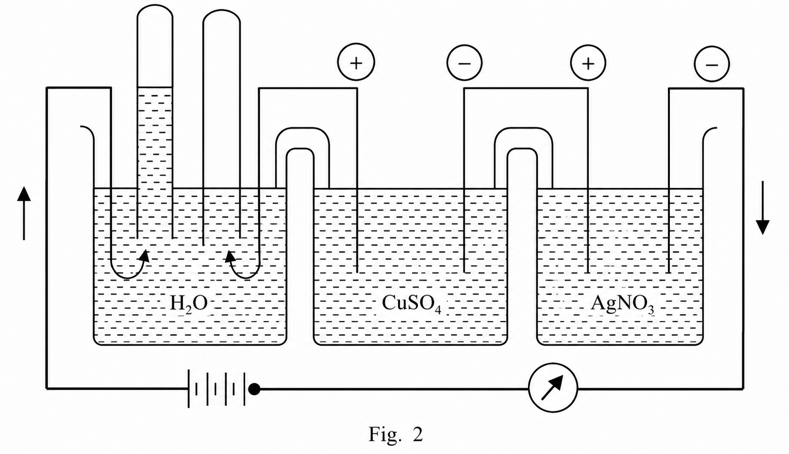
11. Figure 2 represents an experiment in which Faraday’s second law was illustrated by connecting in series three cells containing water to which a very little amount of dilute sulphuric acid, copper sulphate solution and silver nitrate solution was added. A current of 1 A was passed through the solution for 2 seconds.
The volumes and hence weights of hydrogen and oxygen liberated were calculated. The weight of copper and silver formed by the electrolysis of copper sulphate and silver nitrate solutions was also measured.
The results of the experiment are tabulated below:
Element
Current I
Time t(s)
Mass of element deposited in g
Quantity of electricity
Electrochemical equivalent
1. Hydrogen
1.00
2
2.0892 × 10⁻⁵
2. Oxygen
1.00
2
1.658 × 10⁻⁴
3. Copper
1.00
2
6.587 × 10⁻⁴
4. Silver
1.00
2
2.236 × 10⁻³
(a) Complete the table above by calculating (i) quantity of electricity passed in experiments 1, 2, 3 and 4. (ii) electrochemical equivalent of the elements in experiments 1, 2, 3 and 4.
(b) If the Faraday constant is given as 96,500 C, calculate the chemical equivalents of (i) hydrogen (ii) oxygen (iii) copper (iv) silver.
(c) What relationship is there between electrochemical equivalent of an element and its chemical equivalent?
12. (a) Indicate clearly whether a chemical or physical change is involved in the following processes.
(i) The addition of sodium metal to water.
(ii) Dissolving of sodium chloride in water.
(iii) The heating of magnesium in air.
(iv) The heating of ammonium chloride.
(v) The addition of concentrated sulphuric acid to water.
(b) Name two (2) non-metallic oxides which cause pollution to the atmosphere.
(c) 25 cm3 of sulphuric acid were neutralized by 27 cm3 of 0.1 M sodium hydroxide. What is the concentration of the acid solution in terms of (i) mol/dm3? (ii) g/dm3?

 For Call,Sms&WhatsApp: 255769929722 / 255754805256
 MATOKEO YA KIDATO CHA VI 2026