Chapter 02 : Industrial revolution in the 18th and 19th centuries
| Introduction The 18th and 19th centuries saw the transformative impact of the Industrial Revolution. The period was characterised by rapid technological advancements, economic growth and profound changes in the society. In this chapter, you will learn the concept of industrial revolution, phases of industrial revolution and the impact of industrial revolution. The competence developed will enable you to appreciate technological innovations that transformed the society from agrarian to industrial society. |
| Think Economy without technology |
The concept of industrial revolution
Industrial revolution refers to a series of technological changes and innovations that transformed industrial production from cottage to factory system between 1750s and 1840s in Western Europe, notably England. Innovations such as the spinning jenny and steam engine revolutionised industries, such as textiles, mining, and transportation. It involved a complex process that brought dramatic social, economic, technological and political changes in human history. Generally, industrial revolution marked the beginning of massive industrial production; cumulative structural changes in the economy; the rise of complex class dynamics, such as changes in the class structure, composition and relations; urbanisation; and emergence of new political institutions.
Phases of industrial revolution
Industrial revolution is divided into several phases, each characterised by different technological advancements, economic changes, and social changes. Between the mid-18th and the late 19th centuries, industrial revolution evolved into two main phases, notably the first industrial revolution and the second industrial revolution.
The first phase of industrial revolution (1750s-1840s)
This period witnessed the beginning of structural transformations in the history of European industrialisation.
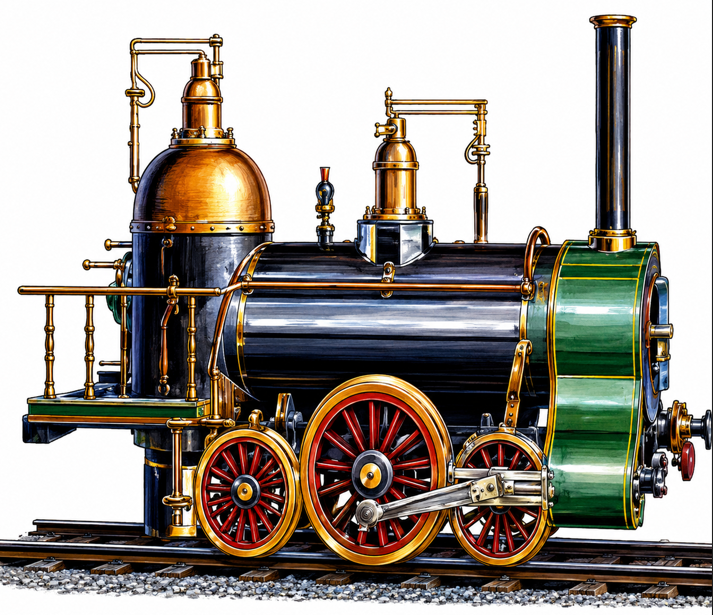
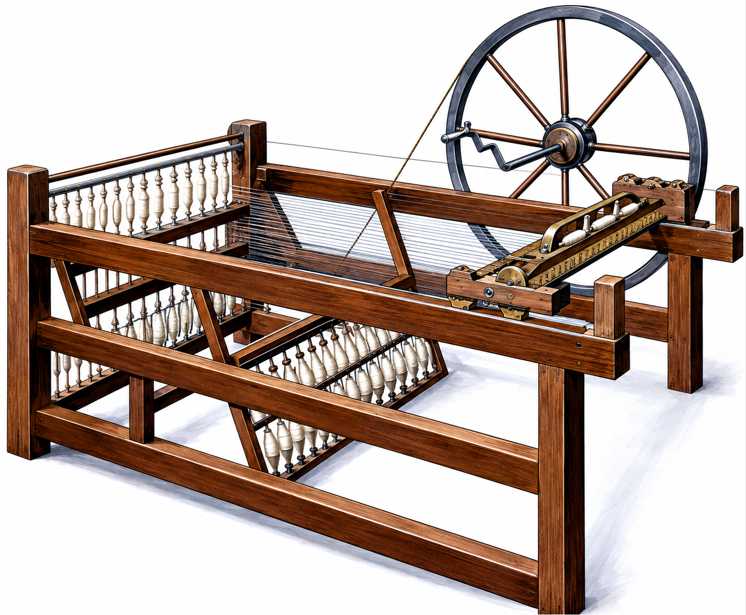
To historians, these transformations were categorically associated with the emergence of the first industrial revolution, which existed between the 1750s and 1840s. This phase was characterised by initial innovations through trial and error. The industries at this phase focused on producing consumer goods, primarily dominated by textile industry. Figure 2.1 shows the initial innovations during the first phase of industrial revolution.
|
(a) Steam Engine
|
| (b) Spinning Jenny Figure 2.1: Some of the innovations in the First Phase |
The cottage system (Putting-out system)
The term “cottage industry” refers to the period when skilled craftsmen and artisans crafted goods within cottages, utilising their own equipment and resources. The cottage industry was a small-scale industry with light machines that applied simple technology in labour force consisted of individuals, family units, or close-knit communities working at home with their own equipment. Under this system, the methods of productions were not industrialised techniques and labour intensive. The production of goods was increased by employing more labour and lengthening labour time (longer working hours). The cottage system was characterised by the putting-out system, which predominated the pre-industrial period. Under this system, the producers (craftsmen or artisans) did not involve themselves in selling their goods. Rather, they put them out for middlemen to sell them to the market. Having sold the goods taken from the craftsmen, the middlemen also bought back raw materials and put them out for craftsmen to produce more goods. This mode of industrial production was very common during the mercantile era.
Features of the cottage system
The cottage system achieved some mechanisation, but it was rather primitive. Mechanisation was mainly powered by animals, wind and water. Its production was handmade by hand technology, because it involved the use of manual labour. Cottage industries used simple machines operated by hand. This usually resulted in slow production of goods.
The cottage system operated in the putting-out system, which meant that the producer (craftsman or artisan) did not sell, and the seller (merchant) did not produce. Hence, there was no direct participation of producers and sellers in the whole production process in the case for industrial capitalism. While craftsmen-controlled production, merchants acted as middlemen who facilitated the exchange of commodities. This was quite different from industrial capitalism, whereby the capitalists controlled all processes from production to the selling of goods.
The guild system guided the cottage industries. This system was based on apprenticeship as an entry qualification to specialisation such as craftsmanship. Entering into a specialisation was a very restrictive process, which demanded very serious training. This system was common at towns; hence, under this system, occupational specialisation was entirely by training and experience. The guild system was established to protect and safeguard the interests and rights of a group of certain craftsmen like tailors and weavers.
In the cottage system, industries were locally organised and were usually located at home. The family remained both an economic and social unit. It was a domestic system of production as home life and working life were closely related. Producers tended to use simple technologies to address the needs of people. Thus, this kind of industrial undertaking was simple and financed by a small capital. Most industries were located in the villages and along river valleys. The towns were mainly used as commercial centres, which were under a strict guild system. Thus, many industries shifted to villages to escape from the guild restrictions. Likewise, most industries under the cottage system were powered by water and wind power. Water could be easily obtained in the river valleys; hence, industries were located along the river valleys.
Proletarianisation of the producers was also a widespread phenomenon preceding the factory production system. Cottage system went hand in hand with proletarianisation of independent producers. Many peasants lost ownership and control of the means of production through the enclosure system. On the other hand, the merchant manufacturers loaned the producers (craftsmen or artisans) who became indebted under the putting-out system. These independent producers were impoverished, and they had no option for livelihood except to become proletarians. Similar proletarianisation process happened to impoverished landlords.
| Activity 2.1 Explore online and library resources on the British cottage industries then:
|
Transition from cottage to factory system (1750–1870s)
As noted earlier, before the industrial revolution, the production of goods was done under cottage industries, which were small-scale industries usually run manually at home. Under this system, the production was slow and inefficient. However, the cottage industries struggled to keep pace with the growing demand due to the increase of population. As a result, producers, entrepreneurs and inventors sought ways to an increase production, which ultimately led to the invention of the factory system in the mid-18th century.
The factory system was a form of manufacturing based on the concentration of industries in specialised and often large establishments. Under this system of industrial production, all operations and production processes were conducted under one roof. The establishments of factories led to the rapid growth of urban centres as people migrated from rural areas to towns in search for employment opportunities in the newly emerging industries. This resulted in the increase of urban populations and the creation of densely populated industrial cities. As people moved from rural areas to urban centres to work in factories, rural communities experienced depopulation. This migration contributed to the decline of cottage system lifestyle. The factory system developed first in Britain and later in other Western European states.
From the mid-18th century, the factory system was increasingly associated with industries that were more concentrated in towns, an increased mechanisation of industrial processes, especially in the use of power, and the ownership of factories became concentrated in fewer hands. By the late 18th century, there were significant observable transformations of development. Production increased through improving production techniques, such as replacing labour productivity. Karl Marx calls it “revolution in Department I Industries,” which produced consumer goods (goods produced for immediate use).
Britain as the first country to industrialise in Europe
Britain was the first country to undergo industrialisation in Europe, and was the first country to experience industrial revolution globally. She had no examples to emulate. Then, a question arises: why did Britain, and not any other country, industrialise first? This question calls for the examination of internal dynamics of industrial development within Britain and the external forces which hastened the whole process of industrialisation. In this regard, we should identify Britain’s relative advantage over the other European states. The following were the reasons for British industrialisation.
The first reason was its geographical position. Being an island, Britain was geographically isolated and safe, especially during the wars. While the other European states lived close to each other concentrated in fighting, Britain concentrated in production and capital accumulation, which strengthened her economy. Britain accumulated much capital and raw materials from the other trade and supplied goods to the other European countries that were fighting.
Second, Britain’s environment was endowed with plenty of natural resources, such as coal and iron. These natural resources became important for industrialisation. For instance, coal was the most important source of energy, as it revolutionised steam power (steam engine), which was very important for industrialisation.
Third, Britain had good harbours, rivers and canals, and a well-developed marine transport system. By the early 19th century (1820s), England had 40 per cent of the world’s shipping companies operated by British East India and British West India companies. Through these transport networks, Britain easily gained raw materials to feed her industries, cheaply transported labourers to the production areas and cheaply transported manufactured goods to the market centres. Other European powers had no such advantages.
Fourth, the agricultural revolution was another reason for British industrialisation in Europe by the mid-18th century. The agrarian transformation took place because of the adoption of new methods of farming (crop rotation), the use of agricultural machinery (seed drill), new crops (clover; fodders) as well as new animal breeds. All these increased agricultural productions, thereby leading to abundance of raw materials, such as wool, to feed the growing woollen
industries in Britain. The agricultural revolution increased food production, which made people comfortable and healthy. This led to rapid population growth that acted as labourers and buyers. Through enclosure, the agrarian revolution created labour force that was instrumental in industrial development in Britain. Therefore, enclosure were circumstances, industrialisation was relatively guaranteed in Britain.
Fifth, the remarkable success in mercantile trade and commerce largely contributed to the growth of British industries in Europe. From the mid-17th century, Britain accumulated huge capital, which was later invested in industrialisation. Ways such as enslavement (slave trade), plundered (piracy and looting), navigation acts, unequal exchange, colonisation and the enclosure system, were responsible for capital accumulation. For instance, by the 16th century, Britain had the lion’s share of the world colonial possessions. She was controlling almost twenty-five per cent of the world colonies. She had colonies in the Caribbean Islands, Australia, Canada and the Americas. In these colonies, she produced raw materials such as sugar, cotton, and tobacco. These were prime sources for British industrialisation. Such colonies also acted as ready-made markets for her manufactured commodities. This assured Britain of super profits through unequal rates of exchange. Thus, by the second half of the 18th century, Britain had accumulated vast amount of wealth, which was invested in the industrial development.
Sixth, a cluster of inventions and innovations was another vital factor for Britain’s industrialisation. The inventions and innovations were the impetus for industrialisation because they attracted new machines and production methods. One industrial branch that received enormous development in the movement in the 18th century was textile industry, especially the spinning sector. A new method of yarn extraction was another great experience in massive transformation. Between 1783 and 1784, the puddling and rolling method was among two was invented. Coal was also used instead of charcoal in iron smelting. Since coal was a new invention itself, this became cheaper and quicker to produce. Large ironworks were then located in coal field, which saved forests. The availability of cheap and abundant iron ore stimulated growth in other industries like machine building, shipbuilding, construction, hardware, and agriculture. The steam engine was another important innovation in the second half of the 18th century. It had far-reaching impact on industrialisation without which the industrial revolution could be delayed.
Seventh, the contribution of key individuals, such as James Watt and Richard Arkwright, was another reason for British industrialisation. James Watt, a Scottish engineer and inventor, made important contributions to industrial revolution through his improvements to the steam engine. In the 1760s, he developed a separate condenser that prevented the loss of steam, greatly enhancing the efficiency of steam engines. This innovation allowed steam engines to be used in mines and textile industries. Watt’s steam engine became the driving force for mechanisation of many industries, revolutionising production processes and contributing to industrial revolution in Britain.
Richard Arkwright, on the other hand, was an English entrepreneur who invented water frame, a spinning machine powered by water. This invention revolutionised textile industries by increasing the speed and efficiency of production. Arkwright’s water frame enabled mass production in the textile industries and helped Britain to become a dominant force in the global textile trade. Additionally, Arkwright’s factory system, which centralised production in large-scale factories, introduced new methods of organisation and management that became characteristic of industrial capitalism.
Eighth, the government also contributed to the emergence of British industrialisation. It passed favourable trade and economic policies that positively supported a steady growth and stability of the economy. The government practised maximum intervention to its merchants and ensured a peaceful environment for people to do their business effectively. The government strategically protected and promoted the British merchants by removing or charging minimal internal tariffs. For example, the government enacted many laws to protect the merchants and their wealth (trade). The Navigation Acts (also known as Elizabethan laws) of 1651 and 1660 serve as examples of such laws. These were a series of laws passed by the British Parliament between 1651 and 1733 to regulate trade and colonial affairs. The first Navigation Act was passed in 1651 under Oliver Cromwell. When the monarchy was restored in 1668, the parliament renewed the earlier act. However, both Acts declared that only British ships would be allowed to bring goods into Britain, and that the North American colonies could only export their commodities such as tobacco and sugar, to Britain. These enforced the policies of mercantilism, which stated that colonies existed to benefit the mother country’s economy. With this government’s help, the British merchants freely and comfortably traded domestically and internationally, becoming the most dominant merchants in the mid-17th century. This dominance gave them an added advantage over the other western European states in capital accumulation.
Ninth, the rapid development of financial institutions also accelerated the rise of British industrialisation. From the early 17th century, Britain enjoyed a commendable pace of capital accumulation through primitive accumulation. It was among the first countries to establish and develop very strong financial institutions, such as banks and insurance companies. These institutions were crucial pillars of industrialisation in Britain. Banks such as Barclays provided capital in the form of loans to assist upcoming capitalists in investing and reinvesting in industrial development. Equally significant, insurance companies, like the LloydInsurance Company, assured and instilled peace of mind and confidence in merchants to invest heavily in industrialisation because insurance covered the security of their capital (assets) and products. Therefore, the development of these institutions was one of the instrumental forces for British industrialisation, contrary to the other European states whose financial institutions were still infant. Other well-developed institutions in England that later became vital to industrialisation were joint-stock and stock market exchange companies.
Tenth, the demographic revolution played an important role in the emergence of British industrialisation in the 18th century. Britain experienced a rapid population growth due to agricultural revolution. Agricultural development guaranteed enough food production and a comfortable life to people. Also, the high population created enough demand for industrially manufactured goods, thus ensuring a reliable market base provided cheap labour force because as many town dwellers sought jobs, and others were employed in new commercial agriculture to produce raw materials. With all these, the industrial revolution was guaranteed in Britain.
Finally, the great success in business ethics and entrepreneurial skills also contributed to the development of British industrialisation. Britain, which had many entrepreneurs with capitalist business ethics and trading skills, developed from their experiences in international trade since the 15th century. These people knew how enterprises could be managed to realise super-profits. In this regard, capitalist ethics and spirits developed earlier in Britain than in other European states. This gave Britain a relative advantage to start a cash nexus, which is the backbone of the capitalist industrial development. The trend was different from the other states that proceeded with a social nexus of feudal relations for a long time, thus making their efforts to achieve industrialisation. With all these factors, Britain easily and swiftly entered into industrialisation. These entrepreneurs promoted industrialisation because they had both capital and experience in investment and profit-making in the society.
| Activity 2.2 Study online and library resources on the innovations and pilot industries that promote cottage industries then compose an essay to advise the contemporary policy makers on the ways to promote small-scale industries in Africa. |
Industrial revolution and the rise of working-class movements in Britain
From the Marxist point of view, a worker or a proletariat is defined as a person who does not own any means of production, such as factories, machines, land, mines, buildings, or vehicles. He/she survives by selling his/her labour power for wages. A working-class movement is a form of collective consciousness involving a group of workers or wage earners united with the same interests of opposing exploitation, and oppression of their work places, such as industries and farms. The shift towards industrialisation often led to poor living and working conditions, such as overcrowded housing and poor sanitation for the workers in the emerging urban centres.
Moreover, because many unskilled jobs could be performed by women, men, or children, factory wages were driven down to subsistence levels. Therefore, factories were characterised by poor working conditions, long working hours up to 16 hours a day, and low wages. From the early 19th century, these harsh conditions gave rise to working-class movements in which workers struggled to improve their conditions through collective action.
The factory workers’ protest
Industrialisation created a new environment for work. During the First Industrial Revolution, the transition from cottage to factory system concentrated workers in big industrial units in emerging industrial towns. The workers were organised into specialised divisions of labour, where they performed only any part of the total labour going into production. At the same time, the instruments of production were concentrated in the hands of a small class of industrial capitalists. The previous freer workers started working under the threat of economic deprivation during the First Industrial Revolution.
In the early period of industrialisation, the new industrial working class was less organised, except in the traditional industries which had gained experience in the guild system. These workers faced many problems, and they reacted by protesting. Early industrial workers protested in three different ways. Firstly, they used peaceful strikes. This type of protest was very rare. Secondly, they reacted by sending petitions to the King, Parliament, or the Magistrate. This type of protest was an appeal to the traditional authority for solving their grievances. For example, up to 1809, magistrates had the power to fix wages. Usually, this form of protest was unsuccessful. Thirdly,they reacted by rioting. The majority of the workers preferred rioting. This was because petitioning did not produce the expected results. At the same time, workers’ movements or combinations were in most cases forbidden by law.
Combination laws forbade workers to join together to force employers to pay better wages and improve working conditions. Such laws were passed at different times during the 18th and early 19th centuries. The laws against combinations, grouping, or association culminated into the General Combination Acts of 1799 and 1800. These Acts made all combinations illegal. Those who acted contrary to these laws were prosecuted and, if convicted, were severely punished. Regarding the pattern of protests, rioters usually attacked persons or the property of their employers. They also attacked their fellow workers who offered to work while others were on strike. There were usually two types of riots; riots aimed at protecting the workers against wage cuts and riots aimed at protecting workers against the threat of new machinery or factory system. Such protests led to machine breaking incidents. Although riots in the 18th century mainly occurred in secrecy, the latter protests manifested themselves openly in the early 19th century. The most famous episode of violent protests was known as Luddism, which is described in the subsequent section.
Luddism or Luddite Movement, 1811-1817
Luddism was the name given to a violent protest movement in England involving a group of workers who secretly organised themselves to destroy manufacturing machines, believing that the machines caused unemployment. In short, the Luddite movement was the widespread machine breaking movement from 1811 to 1817. It was an underground movement whose membership was subject to the administration ofaths. The movement was named after its legendary leader, General Ned Ludd, who signed threatening letters sent to employers and government leaders. In reality, the movement was not unified as workers of different employers or industries fought in isolation. Thus, perhaps many General Ludds were organising different groups of workers in England. If there was one Ludd, the movement would be unified under his leadership. However, it would be very naïve to describe the Luddite movement as a blind opposition to machinery. The main issue at stake was the freedom of the capitalists to destroy trade customs. Capitalism destroyed traditional occupation by introducing new machinery, the factory system, lowering wages, and undermining standards of craftsmanship. The new capitalist system angered workers who witnessed many negative dramatic changes.
Causes of the Luddite movement
There were two causes for the rise of the Luddite movement in England. These were economic depression of 1811-1812 and structural changes in the British economy. To start with the economic depression and its impact on Britain: Luddism was a very active movement during the depression, especially between 1811 and 1812. The economic depression resulted from many events, including the Napoleonic Wars. France imposed Napoleon’s Continental System during the wars, which practically blocked British trade with continental Europe. Britain reacted by introducing the British Orders-in-Council, which blocked trade with France and her allies.
There were also the American Embargo Act of 1807 and the Non-Intercourse Act of 1809. These two American acts virtually closed the American market to British manufacturers. Thus, all those disrupted the market for British textiles. As a result, the industries of Lancashire, Yorkshire, and the Midlands were stagnant. The British textile industry was the most affected sector, negatively affecting the workers whose salaries were lowered. The employers reduced wages and introduced labour-saving devices such as power-looms and shearing frames. These devices economisedlabour and cheapened its value, seriously offending the working class. Hence, Luddism erupted from the economic difficulties that emerged because of these economising strategies.
Crop failure also contributed to the rise of Luddism. The failure raised the rise of food (bread), which led to the bread crisis. The crisis became well deeper in 1801 when Russian Tsar Paul I imposed embargo on British ships and their crews in his spheres of influence. This embargo meant that the bread scarcity became worse because Britain could not import wheat and flour from the Baltic state, which were substituted as alternative sources during hard times. With the Russian embargo, Britain could not access this area. As a result, the price of bread kept rising from 1801 to 1813. The higher price of bread negatively affected many workers who were paid meagre salaries. Thus, many poor families starved. Under these circumstance, workers organised themselves against the system through the Luddite movements.
The structural changes in the British economy were associated with the rise of factory system that affected cottage industries. As a result, most of the artisans and craftsmen lost employment. Unemployment caused by the inventions of machines and factories triggered the outbreak of the Luddite movement in Britain. In this regard, human and animal labour was replaced with machines. Thus, many workers were laid off as there were no more employment opportunities in the new industrial system. Such circumstances forced the workers to come up with the Luddite movement to show their discontents with the new machines.
Luddism was also influenced by the intensive exploitation of workers by industrial capitalists. Industrial ownersconcentrated much on profit maximisation at the expense of workers’ welfare. Within the new capitalist industrial system, workers were exploited in two main ways: they were lowly paid and they were subjected to long working hours. The wages paid were lower than the output they produced in the factories. Besides, workers worked for long hours, ranging from 14 to 16 hours which exhausted them. The workers were not paid for the extra working hours. Such maximum exploitation compelled workers in Britain to rise against the new capitalist industrial system.
Poor living and working conditions contributed to the grievances that forced the Luddites to resist the new industrial system. One of their demands was to go back to their pre-industrial customary life, which was noiseless, clean and safe. These claims were made to oppose the heavy pollution caused by the new factory system. The industrial revolution caused air, water and noise pollution. These had negative impact on the health of workers whose settlements were overcrowded with substandard homes with poor sanitation. All these led to frequent eruption of diseases, such as cholera and dysentery. As a result, the workers demanded the return to their old lifestyle of handlooms.
Organisation of the movement
The organisation of the Luddite movement was rather complex. The movement was highly secretive and organised mainly during the night. Membership into the movement was assumed by the administration of an oath. Members who solemn oath to keep the secret about the movement. The Luddites mainly attacked machines using a big hammer called Enoch Taylor. The pattern of attacks went as follows: (a) There were threatening letters signed by General Ludd. These letters were sent to employers as alerts for their calls to make necessary changes, failure to which they were liable to the Luddite attacks; (b) Letters were then followed by the actual breaking of the machine, which was done by small, disciplined groups whose members were armed with clubs, sticks, swords, guns, pistols hatchets and hammers. The groups moved swiftly and quietly from village to village away from factory to factory at night, executing the machines.
Strengths of Luddism
In essence, the Luddite agitators systematically smashed machines that were putting handicraft workers into poverty and starvation. The movement mainly happened in the textile industrial towns. The signal for Luddism came first from frame-work knitters in Midlands. The movement was more evident in the Midlands (Nottingham, Derbyshire and Leicester). South Yorkshire and Lancashire. Generally, Luddism was not a blind protest. It was not even a form of primitive trade unionism. According to Edward P. Thompson (1963), The Making of the English Working Class, some Luddites were the most articulate social critics, such as a few had heard Adam Smith, a Scottish political economist; and others had studied trade union law. Furthermore, croppers, stockers, and weavers could manage a complex organisation; all had dealings with Parliament via their representatives. Moreover, croppers and shear men were skilled and privileged workers. They were among the aristocracy of the woollen workers. Weavers and framework knitters were out-workers with long artisan traditions.
These workers were aware that their status had been made insecure by the introduction of machines, which could change they enjoyed from elite into an order of men who were not relevant to the manufacturing industry. They believed that protection against displacement by machinery was their constitutional right. The Luddites smashed only those machines or frames which manufactured under-priced or cut-up works.
Being the first organised and smart workers’ movement in Britain, Luddism brought more lessons and discussions to workers and society. It exposed the evils of capitalist exploitation as the main discontent of workers and how they were supposed to respond to them. In this respect, Luddism laid a foundation for developing other workers’ movements, such as Trade Unionism, Chartism and New Model Trade Unionism. It also provided an early methods of class consciousness to deal with exploitation under capitalism. Therefore, the legacy of Luddism has remained essential in the history of working-class movements in Britain and the world at large.
Despite its achievements, Luddism had several inherent weaknesses, which contributed to its failure.
The Luddite movement lacked an effective leader. The movement had no single united leadership. Even the purported leader, General Ned Ludd, has never been proven to have led the movement. The claimed there were many unknown Ludds. Available evidence does not suggest the presence of a unitary leadership of the movement. In this regard, the movement was in most cases directionless because it lacked a strong leader with a well-defined philosophy and ideology. This was one of the major weaknesses which contributed to the failure of the movement.
The movement also failed since most Luddites were poor. What they earned was a minimum wage to support their daily survival. This financial constraint made them fail to manage and finance the activities in good order, thus, weakening the movement to a total failure.
Another weakness was ineffectiveness and a lack of consistency. The movement was not consistent because sometimes the Luddites were active, especially when the economic crisis erupted. When the wages and working conditions were somewhat improved, they stopped their movement. This weakened the movement because it lacked continuity and cohesiveness. The limited scope of the Luddite movement laid a foundation for its failure. The movement was done in isolation. It was done by few workers from few industries localised and restricted to certain areas with many factories, such as Lancashire, the Midlands and South Yorkshire. It was not nationwide. To other workers, it seemed like it was none of their business because it concentrated only in the textile industrial towns. Because the movement involved a few labourers who reacted against their employers in isolation, the government would easily contain them.
The government repression also contributed to the failure of Luddism in England. The government acted against the movement so repressively and oppressively. It stood with the capitalists and as a crime against the state and private property, hence dangerous to the British economy. Thus, those who were found and caught organising the movement were severely punished by the government. For instance, in 1812, the government passed a law that made the breaking of machines a capital felony. Such repressive punishments weakened the movement and thus, it was bound to fail.
Luddism was conducted by workers who lacked enough experience in organising mass protest movements. That means, they had low level of class consciousness. For instance, the Luddites failed to unite against a common cause because the minimal level of consciousness affected their unity. Thus, only workers of the same factory or occupation rose against their employer. Disunity, therefore, became one of the major stumbling blocks in organising a strong working-class movement.
www.learninghubtz.co.tz
Exercise
1. Compare and contrast the working conditions in cottage industries with those in early factories during the industrial revolution.
2. How did the transition from cottage industries to factories impact the population patterns during the industrial revolution in Britain and Western Europe?
3. How did Britain’s geographical location influence its early industrialisation?
4. Describe the major technological advancements that fuelled Britain’s industrial revolution.
5. What lessons can we learn from Luddism movement?
Chartism or the Chartist Movement, 1830s-1850s
Chartism was a nationwide working-class movement that agitated parliamentary reforms to achieve the socio-political demands of industrial workers in Britain. The chartists aimed at gaining political rights and influence for the working classes. The movement got its name from the People’s Charter that listed the six political demands. Such political demands were universal manhood suffrage, equal electoral districts, vote by secret ballot, annually elected parliaments, and payment for members of parliament. It was the first movement to be both working class in character and national in scope. It grew out of protests against the injustices of the new industrial and political order in Britain.
The development of this movement can be summarised into three broad phases:
(a) The formative phase of Chartism, 1829-1837: This was a period when Luddites looked backwards to old customs and paternalist legislation, which could never be revived. The movement wanted the revival of pre-industrial customary life. They wanted the old technology which was under the cottage system to prevail. This was largely impossible because they were fighting against time and the reality of progress. the ground was being laid for the movements before the assumed a mass national character;
(b) The popular phase of Chartism, 1838-1842: This was a period when the movement assumed a national character and came into direct confrontation with the might of the ruling class; and
(c) The decline and disintegration of Chartism, 1843-1850: The movement lost its cohesiveness. However, there were some episodes in this period when Chartism once again resumed its mass national character. However, these were essentially insignificant.
Chartists used the Northern Star published in Britain between 1837 and 1852. It was best-known for advancing the reform issues articulated by proletarian press. O’Connor. The paper led a campaign in support of the working class which suffered economically due to the introduction of new technology and falling wages, especially for handloom weavers. In 1838, the Northern Star circulated 10,000 copies, and by summer 1839 the number had increased to 50,000 copies. This enabled Feargus O’Connor to make a personal profit of £13,000 by the end of 1839. The newspaper was the second largest circulation compared to the other British newspapers at that time. This means, more Chartists were informed about the progress and direction of the struggle.
Strategies of the Chartist Movement
The Chartist movement used various strategies to present its demands and interests to the government. The most common strategy was to submit petitions to the Parliament. The Chartists presented three petitions to the Parliament in the course of their struggle, and all of them were summarily rejected. The first petition was presented to the Parliament in June 1839 with over 1.25 million signatures. The second petition was presented in May 1842, signed by over three million people. In April 1848, a third and final petition was presented. Besides the petitions, the movement also used riots, such as the riot of 1839 in Birmingham, which pressed the government to accept the petition. Furthermore, strikes and demonstrations, national conventions, newspapers (the Northern Star), and pamphlets were used to awaken workers to demand their rights and welfare. The Land Plan project was also used to enrich the workers to become independent from the capitalist tentacles of exploitation. This project began in the mid-1840s, and failed in the 1850s.
Causes of the Chartist Movement
The Chartist movement was a product of many causes and discontents. The first cause of Chartism was the impact of the British Reform Act of 1832. In the 2-year campaign for the Reform Bill, from 1830, workers collaborated with the Whig Party, which represented the interests of the rising industrial bourgeoisie (middle class) against the Tory Party, which represented old feudal interests based onlanded gentry. The industrial bourgeoisie was still largely excluded in the Parliament and, therefore, had no political power to match their rising economic power. During the agitation, the middle class drafted the working-class crowds to frighten the old ruling class. For instance, they campaigned for the abolition of rotten boroughs (constituencies that could elect a member of parliament despite having very few voters, the election was typically in the hands of one person or family) and extension of the voting rights to all people with property. Indeed, the Reform Act of 1832 increased the political power and influence of the middle classes on decision-making bodies. However, after the Reform Act, the working class felt betrayed by the bourgeoisie because nothing changed in their part. For example, the bourgeoisie still suppressed trade unionist and the working-class press. They also refused to repeal the Newspaper Stamp Act of 1819. The newspaper had been paying stamp duty, despite O’Connor’s protests that the tax restricted free speech for the working classes. O’Connor used the paper to help propagate the essence of the movement, to achieve reform ideas of the People’s Charter. In this regard, the working class conducted their independent movement against the industrial capitalist system, which was both exploitative and oppressive. This marked the beginning of the independent working-class movement called Chartism.
The New Poor Law was another important cause of the Chartist movement. This law stemmed from the amendment of the Old Poor Law in 1834. The New Poor Law oppressed and humiliated the poor, who were mainly factory workers. This is because the Old Poor Law, passed in 1597 and 1601 during the reign of Queen Elizabeth I, gave authority to parishes to charge rates to raise money for relieving the poor. Under this law, the parishes could relieve the poor according to the local circumstances. However, the amended law responded to the needs of the capitalists (middle class) who complained that the poor relied too lavishly. This extravagance, they argued, encouraged the poor to remain idle. To them, poverty (unemployment) resulted from working-class laziness. Thus, they advocated for a less generous poor law to combat working-class idleness.
Consequently, the law was amended in 1834. The New Poor Law came up with unfriendly provisions for the poor. For example, the new law repealed the mandate that parishes could provide relief to the poor. It also created a workhouse test for all able-bodied paupers. That is, outdoor relief for able-bodied paupers was abolished. They had to go into a workhouse where families were separated. The workhouses were ruled by warning men; they were nicknamed ‘prison’. Lastly, it introduced the principles of less eligibility and deterrence. The amount of relief given was to be less than the lowest wage offered in the labour market. The idea was to deter people from seeking relief before they sought work. It was based on the wrong belief that those who sought relief were lazy. The working class generally hated the law. For example, when the law was introduced in the North in 1837, the protest was intensely carried by public demonstrations, riots, petitions and anti-Poor Law literature. This was common to most British towns from the mid-1830s. These protests gave rise to the Chartist movement in Britain. When the economic depression started late in 1836, the feelings of this aggrieved working class were further aggravated. Amidst this atmosphere of discontent and alienation, the British working-class organised themselves, at both local and national levels, the organisation called Chartism.
Protectionist policies, such as the Corn Law of 1815, also triggered the rise of the Chartist movement in Britain. The government passed the Corn Law of 1815 under the Tories’ Prime Minister Lord Liverpool. It aimed at protecting the internal market to the advantage of the bourgeoisie production. The tariffs and trade policy of the time restricted the importation of cereal grains of wheat, oats and barley from outside countries, notably France.
Apart from the Corn Law of 1815, the British Parliament also passed other Corn Laws with the aim of restricting the importation of food between 1815 and 1846. The corn laws were designed to keep grain prices high in favour of the British domestic producers and thus represented British capitalism. Accordingly, the shortage of food and high prices of foodstuffs resulted in economic depression in Britain. It also increased the unemployment level, which intensified hardship for the workers and led to the Chartist movement. Due to the rising prices of food, the working class found itself in living difficulties as they failed to afford the rising prices of food.
Additionally, Chartism was caused by the coercive and oppressive nature of the state against workers in Britain. The government strongly supported industrial owners at the expense of the welfare of the working class. Thus, it suppressed all the workers’ efforts to struggle for their rights. The government enacted laws that suppressed trade unions and imprisoned all those who were leading the unions and movements. Workers became discontented with the situation.
Lastly, low wages and poor working conditions largely influenced the rise of Chartism in Britain. During the industrial revolution, workers were given low wages. The working conditions were very poor and workers worked hard for long hours. They became frustrated by the situation thus, they organised themselves and presented charters to the government to ask for the opportunity to enter into parliament and improve the workers’ remuneration rates.
| Activity 2.3 Study online and library resources on the Luddite and Chartist movements then:
|
The Chartist programmes for political reforms
By 1835, the establishment of workers’ organisations in London and the northern industrial districts inspired radical associations to struggle for the workers’ affairs in Britain. The leading individuals behind these associations was an Irish man, Feargus O’Connor, who was popularly called. In 1836, the London Working Men’s Association (LWMA) was formed, and William Lovett became the Secretary of the association. Most members of these associations were skilled artisans. They worked in close collaboration with the radical members of the Parliament.
In April 1837, the Birmingham Political Union (BPU) was revived. It was under the leadership of Thomas Attwood, a banker who had plans for currency freedom as a solution to the country’s economic problems. However, the two political reforms gained momentum. Both the LWMA and the BPU drew up programmes for parliamentary reforms, which were popular in a nationwide campaign. There were six programmes for political reforms:
Universal manhood suffrage: Chartism struggled for all men to have the right to vote. Thus, Chartism demanded for universal manhood suffrage that would allow all adult males above 21 years old to be voted in the national assembly (parliament).
Equal electoral districts: The Chartists campaigned for equal size of electoral districts or popularly known as borough constituencies because the workers wanted to have equal representation in the Parliament.
Vote by secret ballot: The popular voting system in Britain and Europe at large was by open ballot. This system was intimidation and limited democracy to voters. Thus, the Chartists demanded secret voting to achieve free and fair elections.
Annual Parliamentary Elections: The Chartists campaigned for annual parliamentary elections as opposed to five years’ duration. This aimed at raising accountability and responsibility to members of Parliament. To them, the five-year term encouraged unaccountability and irresponsibility.
Abolition of property qualification: Poor people, most of them industrial workers, were not allowed to vote and to be voted for. Only the capitalists had the right to vote and be voted for because they owned property as an essential qualification. Thus, the Chartists wanted the abolition of property qualification for a person to vote or be voted for. The repealed arrangement denied workers’ the right to participate in politics since many workers, if not all, did not own any property.
The payment of Members of Parliament: The Chartists campaigned for payment of the Members of Parliament because, by then, British Members of Parliament were not paid salaries. This partly, because most of them were rich, middle-class capitalists and land aristocracy who had cash and were self-sufficient workers found this as a big problem. If they were admitted to parliament, they would fail to attend the sessions for lack money. Thus, they campaigned for the payment of the Members of the Parliament.
Significance of Chartism
Chartism was indeed an expression of consciousness among the British working-class because it went beyond narrow and short-term achievements, which is a characteristic of a trade union or working-class consciousness. The Chartists had their eyes on parliament, which was the seat of bourgeois political power. The Chartists correctly pointed out that the bourgeois monopoly of political power enabled them to exploit the working class. The movement exposed that Britain was a bourgeois state promoting capitalist interests. Law (or political power) protected private property, but not labour according to the Chartists, the only way to end the exploitation of the working class was to end the bourgeois monopoly of power in the parliament.
The Chartists’ demands were important, and they were later implemented in the parliamentary reforms. By the 1850s, Members of Parliament in Britain admitted that further reforms were inevitable. Further Reform Acts such as manhood suffrage were passed in 1867 and 1884. By 1918, five of the six Chartists demands had been achieved, only the provision that parliamentary elections be held every year was never fulfilled. This was a great success for the working class. It gave them a new hope that they would have representatives in the parliament, and that their problems would be addressed. Indeed, they formed their political party (Labour Party) in the early 20th century, which later managed to have representation in the Parliament and even took state power.
Weaknesses and failure of Chartism
After more than a decade, the movement lost its cohesiveness. The Chartist popular phase lasted for not more than four years. The movement suffered several weaknesses, which caused its total decline.
Membership and organisation problems: during the Chartist period, the development level of the productive forces was mixed between the old and the new forms of industry. This mixwas reflected in the diverse nature and composition of the Chartist membership. Those in the decaying trades were more militant than those in the new factories. While old trades had long traditions of organisation, especially craftsmen, others did not. Thus, there was always a conflict of values and methods between the violent and moderate groups. In short, the movement split between militant members, on the one hand, and moderate members, on the other.
Leadership problems: one obvious problem with the Chartist leadership was the lack of unity. Thus, bitter quarrels and personality clashes were quite common. The radical and militant Chartists were led by Fergus O’Connor, while the moderate Chartists who favoured collaboration and round-table discussion were under William Lovett. This problem frequently caused hot deliberations in the national conventions, which ended up with undecided issues and frequent withdrawals of the moderates from the conventions. This split among the leadership affected the membership as well.
Unclear ideology: although the Chartists grasped the realities of political power, they did not indicate how the capture of parliament would end their exploitation. There was no reference to the abolition of the wage system to the working-class annexation of the means of production. No theory of socialism could clearly suggest a revolution led by the proletariat over the capitalist system. The sanctity of the parliament as an institution was also not questioned. The Chartists sought admission into the corridors of power to share it with the bourgeoisie. They did not seek the dictatorship of the proletariat. In other words, Chartism was a phase in quest for the completion of the bourgeois-democratic revolution, which started in the 17th century.
Poor economic base: The Chartist movement was also affected by financial constraints to facilitate its projects, campaigns, or programmes. The movement failed to successfully finance its Land Plan Project, which mainly survived by O’Connor’s fortunes. The same was experienced in preparing some publications. The movement depended on O’Connor’s newspaper, The Northern Star, which was later sold because of financial problems. The movement was running through charitable contributions from poor workers. Therefore, they could hardly contribute a large sum of money as most of them were paid low wages. This lack of funds led to the failure of various Chartist activities and programmes. For example, in 1839, when Parliament rejected the petition, the Chartists had a plan to have a month-long boycott called “Holy Month.” However, this plan was unsuccessful because they had no funds to support them during the strike.
Government manoeuvre through oppressive and repressive actions: the government purposely suppressed many Chartists’ activities. For example, in the last National Convention of April 1848 held in London, the Chartists decided to present the National Petition to Parliament once again. The plan was to start with a public meeting at Kennington Common and take the petition across the River Thames to the Parliament in a large procession. The idea was to have the whole crowd present the petition to the Parliament. The government viewed this as a threat to peace. It marshalled military forces of the strength of 170,000 to block the crossing of the Thames. The crowd assembled and militant speeches were delivered. However, owing to the presence of the military, the march was called off. Therefore, the plan failed, and O’Connor advised the crowd to disperse and personally took the petition to Parliament. The government also imprisoned Chartist leaders to threaten and weaken the Chartists’ efforts to wage struggles against the system.
Trade Unionism and the New Model Trade Unionism (1850-1876)
A trade union is an association of workers in the same profession or industry with common interests and needs. Trade unions are formed in organisations and working places to improve workers’ welfare such as wages, working conditions, housing conditions, and reducing working hours. They also aimed at reducing exploitation of workers by their employers. In the mid-1830s, especially with the collapse of the Grand National Consolidated Trades Union, trade unionism gave way to political radicalism and Chartist at the national level.
However, in the 1840s, Britain witnessed the rebirth of unionism. Many national unions emerged when Chartism began to decline. National unions arose among potters, cotton spinners, printers, miners, and fit glassmakers. This tendency continued until the 1850s when a new form of trade union emerged. So, the 1850s saw the consolidation of the reactivated trade union movement, consisting of the “new model unions.” The largest in this development was the 1851, with the formation of the “Amalgamated Society of Engineers” (ASE) under the Secretary-General, William Allan. It headquarters was at Peckham in London. The ASE was a major British trade union, representing factory workers and mechanics in associated of engineers, machine operators, smiths, millwrights and steam-makers. The ASE was dissolved in 1920.
The constitution of the engineers’ union was taken as a model copied by other ‘amalgamated societies’ of skilled workmen. Between 1852 and 1857, amalgamated societies of carpenters, iron founders, tailors, and compositors were formed. The British working-class organisations were now in the form of new model trade unions. These unions were now not only in their structure but also in their modes of operation.
Characteristics of the New Model Trade Unionism
New Model Trade Unions were national craft unions that intended to be centrally controlled, unlike the earlier unions that were mainly local in scope and organisation. These unions were amalgamated in scope; for instance, the Amalgamated Society of Engineers accommodated all engineers in Britain.New Model Trade Unions achieved a permanence of membership hitherto unknown. Unlike the earlier phase of trade unionism, where members were in fluid and mostly temporary terms (e.g. some became members just when they were in crisis), this period witnessed members of the union achieving permanence of membership. Members of the new model unions joined their unions permanently.
Full-time salaried officials ran the union activities. These constituted the first generation of a long line of the professional trade union bureaucracy, contrary to the old unions, which were run and organised by people who had to work full time in the industry and attend union activities in their spare time. Some union officials were then employed to cater for daily union businesses.
The new model unions consisted of highly skilled workers, therefore, they built up large funds from large subscription fees and other contributions. They were thus able to finance expensive welfare system focusing on sickness, funerals, unemployment benefits and strike funds. This was not the case with the old unions and other poor workers’ movements because they collected small funds.
As unions of skilled workmen, they were highly restrictive in practice because they aimed at protecting their vested interests and professions. Thus, they charged high membership fees and allowed into membership only those who had served their full period of training or apprenticeship. For example, ASE was for engineers only; no mechanics could be admitted into it. High membership fee restricted the poor workers who received meagre salaries.
Calling on strikes to improve wages was generally rejected in favour of more reconciliatory methods of achieving their goals. They did not like political confrontations with their employers. Instead, they wanted economic gains out of their professions. Strikes were their worst rather an undesired fate of workers, which was very rare in Britain.
| Activity 2.4 You are to participate in the role the motion “The New Model Trade Unionism laid the foundation for modern labour movements” in a point form, prepare an outline of your presentation. |
Factors for the emergence of the New Model Trade Unionism
As already said, the New Model Trade Unionism emerged in the 1850s with the formation of ASE in 1851 as the first organisation that became a model of all forthcoming unions. These labourorganisations emerged due to the following factors:
The technological revolution (the Second Industrial Revolution) based on the rise of heavy industries gave rise to a powerful “labour aristocracy” such as the engineers. The technological revolution created a class of highly skilled craftsmen in the new industries, especially in engineering.
The gap between the labour aristocracy The highly skilled labourers wanted a new form of union which could accommodate their needs and interests, which were quite different from the needs and interests of the semi-skilled and unskilled workers. Thus, the new model fitted the highly skilled workmen only.
Also, the mid-Victorian economic prosperity diverted many unions from the pursuit of social revolution. Instead, they indulged in opportunism, trying to get as much as possible from the system. The economic prosperity of the mid-1850s reduced unnecessary frictions between workers and employers because wages improved, and high cost of living was reduced. Hence, a new form of labourorganisation was needed to fit with this unprecedented economic growth.
Lastly, the failure of Chartism invalidated mass politics in Britain. By the 1850s, mass political campaigns through demonstrations and strikes yielded minimal success that culminated to the failure and collapse of Chartism. Therefore, a sober and quiet organisation that the old level was then preferred. The New Model Trade Unionism became an alternative to agitative mass political campaigns.
The significance of the New Model Trade Unionism
The New Model Trade Unionism was essential as it changed workers’ conditionsand attitudes. The workers managed to bargain with their employers on terms of the jobs, wages, working conditions and working hours. The trade unions improved the conditions of workers in Britain in the sense that workers achieved their rights through non-violent means.
The New Model Trade Unions pointed the ways towards awareness and consciousness for workers. The stable trade unions made deliberate efforts to educate workers on their rights and the proper ways of demanding such rights. The working class became confident in demanding their rights as workers’ republics could be resolved through constitutional means. Trade unionism acquired government recognition, unlike Luddism and Chartism. This helped the workers to do their activities more comfortably and freely.
Trade unions raised large funds from the entrance fee and annual subscription. The funds accumulated were properly managed, and helped members to run their activities smoothly such as providing education to their fellow workers and assistance to the sick and members who lost employment. Their financial strength helped them to become stronger and to improve the workers’ conditions and living standards.
The importance of trade unions was also vividly seen in their influence on the rise of the Labour Representation Committee (LRC), a base of workers’ political party. It planted the idea of professionalism. In this regard, workers achieved their political and economic rights. The New
Model Trade Unionism had a clear constitutional and democratic ethos of the workers. It had permanent members with strong solidarity that laid a foundation for the establishment of the British Labour Party.
Weaknesses of the New Model Trade Unionism
Their importance aside, the New Model Trade Unions had several weaknesses. For instance, they accommodated only skilled and semi-skilled labourers while isolating unskilled labourers who were the majority. Moreover, they mainly focused on the economic interests of workers and gave little consideration to other issues, especially social and political welfare. In other words, the New Model Trade Unions were opportunistic. Furthermore, their reliance on peaceful means of struggle in many instances delayed the attainment of the intended goals. However, a few incidences of violent methods, such as strikes and demonstrations, were used. Lastly, this form of labourorganisation suited mostly in the stable economic system with high economic prosperity. It could not work in other situations, such as in economic crises. For example, from 1873, New Model Trade Unions lost their relevance and power due to the economic depression, giving way to the formation of the Unskilled General Unionism.
The second phase of the industrial revolution (1840s-1870s)
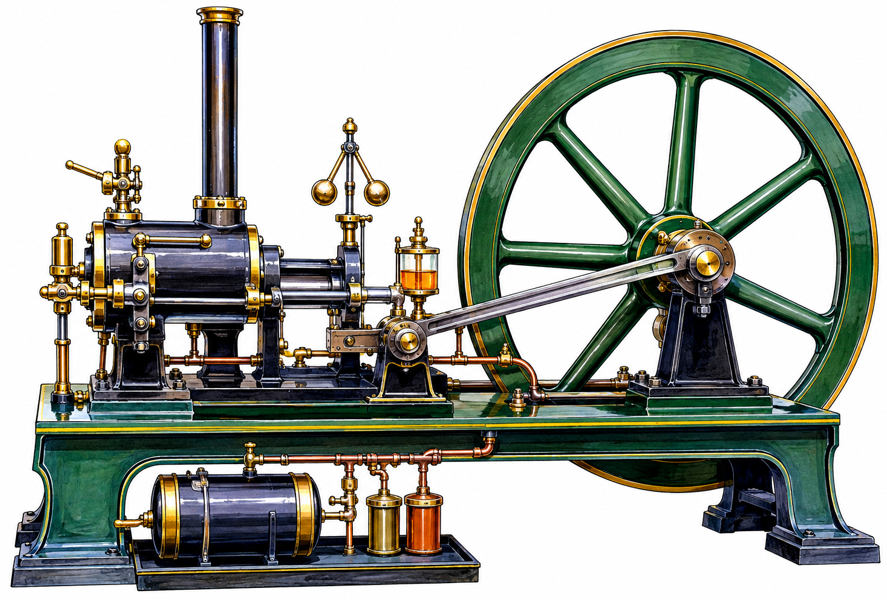
The second industrial revolution, which took place between the 1840s and 1870s, marked the second phase of European industrialisation especially in Britain. During this period, European industrialisation moved from simple to complex and sophisticated industrial technologies. Thus, the second industrial revolution laid the ground for the modern industrialised world, characterised by rapid technological advancements, global economic expansion, and social change. Figure 2.2 shows an example of innovation in the second phase of industrial revolution.
|
Figure 2.2: Internal-combustion engine as innovation in the second phase of industrial revolution |
Features of the second industrial revolution
The second industrial revolution, spanning from around the 1840s to the outbreak of the First World War in 1914, marked a significant departure from the older phase of industrialisation with the prominent role played by “pure” science in industrial development. This period witnessed an unprecedented collaboration among scientists, entrepreneurs, and state officials, driving innovations in industries such as steel, chemicals, and electricity, as opposed to the first phase of industrial revolution, which saw textiles, iron, and coal dominating. This period shifted industrial leadership from Britain to France to other countries such as Belgium, Italy, Germany, and the USA.
Additionally, there was integration of scientific knowledge into industry, facilitated by institutions sponsored by states and universities. These institutions focused on the practical application of sciences like electricity and chemistry, leading to transformative advancements in manufacturing techniques. Technical education became widespread, enabling the breakdown of production processes through the division of labour and the development of machines that replaced enhanced human labour. Advancements in transportation featured the second industrial revolution, with railroads, steamships, canals, and turnpikes shrinking the world and facilitating global trade and communication. This period also witnessed the expansion influence of the western industrial nations, as their political powers extended across Africa and Asia.
Comparing British Industrial Revolution with Belgium, France, Germany and the USA
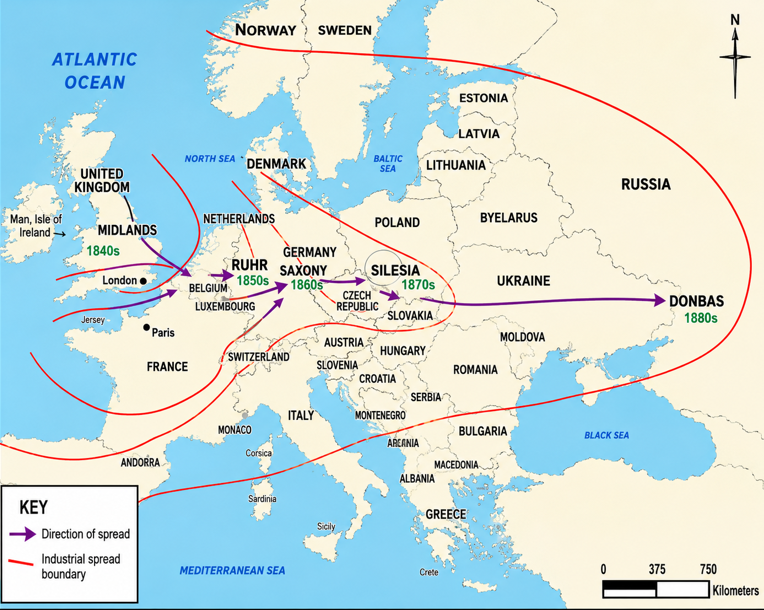
The first phase of the industrial revolution was primarily confined to Britain. In order to continue enjoying the benefits of the industrial revolution, Britain expected her technology by prohibiting the export of machinery, skilled workers, and production technologies. However, other British entrepreneurs saw profitable industrial opportunities overseas. At the same time, other western European nations were attracted to the British achievements and, therefore, were motivated to get the British technologies from the industrialists as well. Thus, various strategies were used to acquire British technology. The subsequent paragraphs explain how industrial revolution spread to other European countries and the USA. Figure 2.1 shows spread of the industrial revolution in Europe in the 19th century.
|
Figure 2.3: The spread of industrial revolution in Europe in the 19th century |
Studies show that British scientist, John Cockerill, brought industrial revolution into existence in Belgium. This scientist developed machine shops at Liège around the early 19th century, which became the focal point of Belgian industrialisation. Thus, Belgium became the second country after Britain to undergo industrial revolution in Europe. Like her predecessor (Britain), Belgium industrialisation was centred on iron, coal, and textiles.
In France, the industrialisation process was slower than in either Britain or Belgium. While Britain was industrialising, France was still in the political revolution and with the Napoleonic wars, which caused unfavourable conditions for industrial development. The chaotic situation in France discouraged significant investments in industrial innovation. France also had a weaker bourgeois class which could not stand alone in the revolution. Hence, they sought the assistance of peasants and other classes. This collaboration slowed the capitalist speed in industrialisation because they had to accommodate some peasants’ needs even after the revolution. This was quite different from Britain, where the class of capitalists was so strong and stood firm to industrialise the country. However, by 1848, France had become the industrial power. Despite the notable growth under the Second Empire, France remained behind Britain.
In Germany, industrial revolution came much later because the country was still divided into many smaller states until 1871. This condition hindered Germany from industrial development. Thus, despite her vast coal and iron resources, Germany did not begin industrial development until 1871 when national unification was achieved. However, a smooth transition from feudalism to capitalism contributed to a rapid industrial growth in Germany after the unification.
Unlike Britain and France, which attained industrial revolution after political revolutions, the German landed gentry, called Junkers, prepared a conducive environment for the emerging capitalists to take over by supporting them financially and politically. Thus, after the unification, German capitalists started without any uncertain political condition which was an added advantage to the German industrial development. Interestingly, after the unification, Germany’s industrial production grew so rapidly. By the 1890s, Germany had surpassed Britain in steel production and had also become the world leader in heavy chemical industries. During the same period, German companies transformed themselves into larger monopolies in the form of cartels and trusts. Thus, by the late 19th and early 20th centuries, Germany had become one of the major industrial powers in the world, competing mainly with the USA.
Industrialisation in the USA also came late partly because it never experienced feudal relations, which were the basis of transformation in Western Europe. Thus, the country had no rich feudal lords who could transform themselves into capitalists, as was the case in Britain. It was not until the second half of the 19th century, especially after the American Civil War (1861-1865) when the USA began to experience rapid industrialisation. The war cancelled the first generation of American capitalists, such as John D. Rockefeller who owned Standard Oil Company (1870), J. P. Morgan and his US Steel (1901), Cornelius Vanderbilt and his American shipping and railroad company (1860s/1870s), who led the process of rapid industrialisation. Thus, although the USA was a late comer in industrialisation compared to Britain, Belgium and Germany, she underwent transformation from competitive to monopoly capitalism in the late 1890s. Western Europe had already undergone monopoly capitalism from the 1870s.
Moreover, the resources available, such as land, water, coal and iron ore plus a big territory which was a result of the union of American states (formerly the thirteen British American colonies) were added advantages for American industrialisation. The immigrants who made America their home also contributed to the America’s industrial development. For example, among the immigrants were some Europeans who were attracted to the United States by the idea of profit maximisation, especially British immigrants who formed about a half of the managers and machine-makers in the USA in the 19th century. These immigrants became instrumental in developing industries in the United States. Their presence positively changed the USA towards industrialisation. Thus, by the end of the 19th century and early 20th century, the USA had become the most powerful industrial power in some sectors, especially in labour productivity, machinery production, electrical engineering and chemical industry, even surpassing Britain.
Exercise
1. What were the distinguishing features of the New Model Trade Unionism in Britain?
2. What lessons can contemporary trade unions learn from the British New Model Trade Unionism?
3. Why did the traditional industrial system in Africa not transform into the factory system as was the case in Western Europe?
Exercise-MARKING
1. What were the distinguishing features of the New Model Trade Unionism in Britain?
(i) It was mainly composed of skilled workers.
The New Model Trade Unions were largely formed by skilled artisans such as engineers, carpenters, compositors and ironworkers. These workers possessed specialized skills and were difficult for employers to replace. Their bargaining position was therefore stronger than that of unskilled labourers.
(ii) It emphasized permanent and well-organized unions.
Unlike many earlier temporary workers’ associations, the New Model Unions established stable national organizations. They maintained permanent offices, elected officials and clear administrative structures. This enabled them to coordinate activities over a long period.
(iii) It relied on regular membership subscriptions.
Members were required to pay contributions regularly into union funds. These subscriptions gave the unions financial stability and allowed them to operate independently. The funds were also used to support members during strikes, unemployment, sickness and old age.
(iv) It provided welfare benefits to members.
The unions offered benefits such as unemployment assistance, sickness support, funeral expenses and pensions. This made membership attractive and strengthened loyalty to the organization. The welfare system also reduced workers’ dependence on employers during difficult periods.
(v) It preferred negotiation to violent confrontation.
New Model Union leaders generally favoured collective bargaining, arbitration and peaceful negotiation. Strikes were regarded as a last resort rather than the first method of struggle. This moderate approach helped the unions gain public respect and legal recognition.
(vi) It adopted strict financial discipline.
Union leaders carefully managed membership contributions and expenditure. Proper records were maintained, and funds were protected from misuse. Strong financial administration enabled the unions to survive long disputes and provide reliable services.
(vii) It employed full-time paid officials.
The unions appointed experienced officials to manage daily activities, negotiate with employers and organize members. These officials were paid from union funds and worked professionally. This improved efficiency and reduced dependence on voluntary leadership.
(viii) It promoted national organization.
Many New Model Unions expanded beyond local workshops and established branches across Britain. National structures enabled workers in different regions to act together. This increased their bargaining strength and reduced the ability of employers to divide them.
(ix) It limited membership to workers who met specific qualifications.
Because the unions mainly represented skilled trades, entry was often controlled. Members had to possess recognized occupational skills or complete apprenticeships. This helped maintain professional standards but excluded many unskilled and casual workers.
(x) It focused on practical economic demands.
The unions concentrated on wages, working hours, workplace conditions and employment security. They avoided revolutionary programmes and direct attacks on the entire capitalist system. Their objective was to improve workers’ position within the existing economic order.
(xi) It sought legal recognition and respectability.
New Model Union leaders worked to convince the government and public that trade unions were responsible institutions. They opposed disorder and promoted lawful methods of struggle. This contributed to the gradual legalization and acceptance of trade union activity in Britain.
(xii) It supported labour representation in politics.
Although initially cautious about politics, the unions increasingly supported laws protecting workers and encouraged parliamentary representation. Their activities helped lay the foundation for organized labour politics. In the long term, this contributed to the emergence of the British Labour movement.
Conclusion.
The New Model Trade Unionism was distinguished by skilled membership, strong finances, disciplined organization, welfare services and moderate methods of negotiation. Its professionalism and stability transformed British trade unionism into a more respectable and influential workers’ movement.
2. What lessons can contemporary trade unions learn from the British New Model Trade Unionism?
(i) Trade unions should build strong financial foundations.
Contemporary unions can learn the importance of collecting regular membership subscriptions and managing them responsibly. Financial independence enables unions to support members during strikes, retrenchment and emergencies. It also reduces dependence on political parties, donors or employers.
(ii) They should practise transparency and accountability.
Union leaders should keep proper financial records and report regularly to members. Transparent management strengthens trust and prevents corruption. Members are more willing to support an organization when they understand how their contributions are used.
(iii) They should employ competent professional officials.
Modern labour organizations need trained negotiators, legal officers, researchers and administrators. Professional leadership improves collective bargaining and protects workers from unfair labour practices. Officials should remain accountable to members rather than using the union for personal benefit.
(iv) They should provide welfare services.
Unions can establish funds for unemployment, sickness, accidents, funeral expenses and retirement. These services make unions relevant to the daily lives of workers. Welfare programmes also strengthen solidarity among members.
(v) They should prioritize peaceful negotiation.
Dialogue, mediation and collective bargaining can often produce better and more lasting agreements than unnecessary confrontation. Strikes should remain available when negotiations fail, but they should be carefully planned. Peaceful methods also help unions maintain public support.
(vi) They should develop strong organizational structures.
Effective unions require clear constitutions, elected leaders, functioning branches and reliable communication systems. A well-organized national structure allows workers from different workplaces to act together. It also prevents employers from isolating individual groups.
(vii) They should educate their members.
Workers need knowledge of labour laws, collective agreements, workplace safety and union rights. Regular training enables members to participate intelligently in union affairs. Educated members are also less likely to be manipulated by employers or dishonest leaders.
(viii) They should maintain unity and discipline.
A union becomes weak when members are divided by politics, ethnicity, religion or occupation. Contemporary unions should promote common interests and collective responsibility. Discipline is particularly important during negotiations and industrial action.
(ix) They should concentrate on practical workers’ needs.
Unions should give priority to wages, job security, occupational safety, working hours and social protection. Broader political issues may be important, but they should not replace the immediate concerns of members. Practical achievements increase confidence in union leadership.
(x) They should use strikes responsibly.
Industrial action should be based on clear demands, member approval and careful preparation. Unplanned strikes can expose workers to dismissal and financial hardship. Responsible action increases the chances of success and reduces unnecessary suffering.
(xi) They should expand representation beyond privileged workers.
The New Model Unions were strong but often excluded unskilled workers. Modern unions should avoid repeating this limitation by organizing casual labourers, domestic workers, migrant workers and employees in the informal sector. Inclusive trade unionism strengthens the entire labour movement.
(xii) They should participate in shaping labour legislation.
Trade unions should lobby governments for fair labour laws, minimum wages, social security and safe working conditions. Political participation should defend workers’ interests rather than serving individual leaders. Legal reform can protect workers even outside unionized workplaces.
(xiii) They should adapt to technological and economic change.
Modern unions face automation, digital employment, outsourcing and temporary contracts. They should conduct research and develop new strategies for organizing workers in changing industries. Flexibility is necessary if unions are to remain relevant.
Conclusion.
Contemporary trade unions can learn from the New Model Unions by strengthening organization, finances, professionalism, welfare provision and responsible negotiation. At the same time, modern unions should be more inclusive and responsive to the challenges of informal work, technology and globalization.
3. Why did the traditional industrial system in Africa not transform into the factory system as was the case in Western Europe?
(i) Production remained mainly small-scale.
Traditional African industries were generally organized at household, family or village level. Craftsmen produced goods mainly for local consumption rather than for large commercial markets. This limited the accumulation of capital needed to establish factories.
(ii) There was limited capital accumulation.
Most African producers lacked large financial reserves that could be invested in machinery, buildings and wage labour. Wealth was often held in livestock, land or trade goods rather than industrial capital. Without sufficient capital, large-scale mechanized production was difficult.
(iii) The domestic market was relatively limited.
Many communities produced a large proportion of what they consumed. Demand for mass-produced manufactured goods was therefore smaller than in Western Europe. Limited market demand discouraged entrepreneurs from investing in factory production.
(iv) Transport and communication systems were insufficient.
In many parts of pre-colonial Africa, roads, canals and other transport networks were not developed for large-scale industrial distribution. Moving heavy raw materials and finished goods over long distances was expensive. This restricted the growth of national and international markets.
(v) There was limited use of mechanized power.
Traditional industries relied mainly on human labour, animal power and simple tools. Western European factories expanded through water power, steam engines and later electricity. The limited adoption of such technology slowed industrial transformation in Africa.
(vi) Scientific and technological institutions were less developed.
African craftsmen possessed valuable practical knowledge, but there were few formal institutions dedicated to industrial research, engineering and mechanical invention. In Western Europe, universities, scientific societies and workshops supported technological improvement. This difference affected the pace of mechanization.
(vii) The apprenticeship system remained conservative.
Industrial skills were commonly passed from masters to a small number of apprentices. Craftsmen sometimes protected trade knowledge within families or specialized groups. This preserved quality but slowed the widespread diffusion of new techniques.
(viii) Political fragmentation limited wider industrial integration.
Africa contained many kingdoms, chiefdoms and independent communities with different systems of taxation and trade. Frequent conflicts and political boundaries sometimes disrupted commerce. Western Europe gradually developed larger centralized states that supported wider markets and industrial investment.
(ix) Agriculture remained the dominant economic activity.
The majority of Africans were engaged in farming, pastoralism and fishing. Craft production was often seasonal or supplementary rather than full-time. This limited the formation of a large permanent industrial labour force.
(x) Labour was not widely separated from ownership of production.
Traditional craftsmen usually owned their tools and controlled their work. The factory system required large numbers of workers who sold their labour to owners of machines and buildings. This capitalist relationship was not yet widespread in many African societies.
(xi) Long-distance trade often encouraged commerce rather than industrial investment.
Profits from trade were frequently invested in livestock, land, political influence or imported luxury goods. Merchants did not always direct their wealth into mechanized industries. Therefore, commercial growth did not automatically produce factory development.
(xii) The Trans-Atlantic and other slave trades disrupted development.
Slave trading removed millions of productive people from African societies. Raids and wars created insecurity and destroyed settlements. These disruptions weakened population growth, labour availability and long-term economic investment.
(xiii) European colonialism interrupted independent industrial development.
Colonial powers reorganized African economies to produce raw materials and consume European manufactured goods. Local industries were often discouraged or undermined because they competed with imported products. This prevented many traditional industries from developing into factories.
(xiv) Colonial infrastructure served extraction rather than local industrialization.
Railways and ports were mainly built to transport minerals and agricultural products to the coast. They did not usually connect African communities in ways that promoted integrated domestic industries. Infrastructure therefore strengthened export dependence rather than factory growth.
(xv) Imported European goods weakened local producers.
Machine-made textiles, metal goods and other products were often cheaper than handmade African goods. Local craftsmen could not easily compete with mass production. As a result, some traditional industries declined instead of developing into mechanized factories.
Conclusion.
The African traditional industrial system did not develop into a factory system because production remained small-scale, capital and technology were limited, markets and transport systems were underdeveloped, and most labour remained tied to agriculture. Slave trading and colonial policies later disrupted local industries and integrated Africa into the world economy mainly as a supplier of raw materials and a market for foreign manufactures.
Impact of industrial revolution
In essence, industrialisation gave birth to competitive capitalism. This is because industrialisation led to the complete decline of the agrarian-based feudal relations, which were replaced with urban-based industrial relations in the 19th century. In particular, industrial revolution facilitated a great shift from an agrarian society to industrial or urban society.
| Activity 2.5 Read online and library resources on the impact of industrial revolution, then compose an essay suggesting the ways contemporary societies can cope with the impact of modern industrialisation. |
Industrial revolution in Western Europe and the USA led to a dramatic expansion of the financial sector, which helped in the rise of industrial capitalism. Banks had previously served as warehouses for valuables, clearing houses for long-distance trade, or lenders to the nobles and governments, and agents of payments. During the industrial capitalism, they served the needs of everyday commerce and the intermediation of credit for large and long-term investment projects. This changing role of banking institutions promoted the development of industrial capitalism in Western Europe and the USA in the 19th century.
With industrial revolutions in Europe and the USA, the policy of colonial expansion became more visible and gained more strength in the late 19th century. Industrial Revolution created a growing market demand for manufactured goods. Likewise, the need for cheap raw materials increased. The areas to invest surplus capital were also highly needed. This forced the European industrial powers to acquire colonies in politically and militarily weak states of Asia and Africa. These colonies provided a good opportunity for the investment of surplus capital. Besides, Asia and Africa were endowed with natural resources, and had huge potential populations to absorb industrial finished goods. The colonial policy furnished from industrial development led to the further development of capitalism into competitive capitalism.
Moreover, Industrial Revolution led to the abolition of slavery and slave trade and the introduction of ‘legitimate trade’ in Africa. That trade facilitated the exploitation of the African natural resources such as rubber, palm oil, and coconut, which were used to make oil for lubricating machines in Europe. Asia and Latin America supplied a lot of agricultural and natural resources to Europe and the USA which also led to further development of industries, giving rise to competitive capitalism in both regions.
Industrial revolution in Europe led to the emergence of new social classes. As industrialisation was gaining momentum, wealth was increasingly concentrated into the hands of a few capitalists. Thus, industrialisation created new social classes, namely the owners of industrial capital, known as the capitalists or bourgeoisie, and the producers who sold their labour-power, known as the workers or proletariats. On the one hand, the factory owners (capitalists) employed workers and paid them wages. They also controlled the sale of goods to make super-profits. On the other hand, the factory workers lived in misery due to the exploitation of their labour power. This kind of production relations was instrumental in strengthening and stabilising competitive capitalism among the western powers.
Industrial revolution transformed the work experience of factory workers, which led to social consequences. The traditional work experience was disrupted by the fast-paced nature of factory life. Machines operated quickly, and employers emphasised hard work and crucial. New factory rules enforced strict regulations, including punctuality, steady and fast work pace, and limitations on socialising. Thus, restructuring of work habits aimed at imposing an unfamiliar sense of time and coordination and management of factory workers.
Additionally, the development of factory supervision reflected the shifting shape the labour force. Initially, supervision was decentralised, with skilled workers hiring their own assistants. However, this decentralised system was gradually replaced by a more formal and efficient industrial control regime. Foremen were tasked with hiring, firing, maintaining proper work discipline, and representing management interests. This marked a significant shift as workers were subjected to daily control by supervisors, changing the traditional work autonomy.
There was a stiff competition among industrial nations in the quest to consolidate industrial production. Thus, while some profits. In the 1870s, other nations started to challenge Britain’s industrialisation which was also industrialising rapidly. These were Germany, Japan, Belgium, France, Italy, and the USA. The centre of wealth and power was transferred from the former industrial nations to newly industrialising nations. The transfer was necessitated by competition in production and demand.
Industrial revolution brought technological changes in Europe and a new system of production. These changes brought the traditional lifestyle and brought a modern industrial life whereby the largest population came to live in urban centres, depending on industries in production and wages for survival.
It also promoted free trade as a means of expanding the market and sources of raw materials overseas. Such trade permitted transportation of goods and commodities without economic barriers or tariffs.
The trade influenced the production of large quantities of goods for markets outside Europe, leading to competition. It was during this period when laissez faire economy replaced protectionism and dominated European economies. The basic principle of laissez faire was that markets should naturally be competitive. The doctrine of laissez faire became an integral part of 19th century European liberalism. Liberals championed the principles of free trade and free competition in the sphere of economics, seeing the state as merely a passive policeman, protecting private property and administering justice, but not interfering with the affairs of its citizens. Liberals also supported freedom of thought in the intellectual sphere. British industrialists and businessmen quickly associated these principles with their own economic interests.
Military revolution among the European nations was necessary to protect their industrial gains. Strong and powerful military arsenals were manufactured, leading to greater competition as other European nations also started to import the European society into wealthy industrialists who controlled the states through political revolutions of the 17th, 18th and 19th centuries and poor workers as. The functions of governments were to protect private property and international boundaries against threats from within or outside the respective states. It was this period the Europe witnessed the replacement of cavalry by navy, infantry and air force. There were also changes in the size of armies, administration, and management of armies, and the type of weapons that were more effective, devastating and efficient in battles. The military science was also developed. Thus, in the 19th and 20th centuries, military innovations played a major role in imperial expansion in Africa Asia, and the Far East.
| Exercise You are given an opportunity to advise the government on how to develop industries in Tanzania. Use the knowledge gained from this chapter to advise the government on how to promote industrialisation. |
www.learninghubtz.co.tz
Revision Exercise
1. With examples, compare the British industrial revolution to that in Belgium, Germany, France and the USA, between the 1840s and 1870s.
2. How did the invention of the spinning jenny revolutionise textile industries during the first phase of industrial revolution in Britain?
3. With examples, account for the transition from cottage to factory system.
4. Relate the growth of the factory system to the rise of working-class consciousness in Britain.
5. Explain why Britain was the first country to industrialise in Europe.
6. Discuss the way workers struggled against capitalism in the period from the early 1800s to the 1870s.
7. How did the bourgeois government in Britain react to the Chartist demands?
8. Show the connection between Chartism and Labour Party in Britain.
9. Assess the significance of Trade Unionism in Europe.
10. Discuss the contribution of electricity in pushing innovation and industrial growth during the second phase of industrial revolution.
11. Assess the impact of James Watt’s steam engine on the first phase of industrial

Hub App
 For Call,Sms&WhatsApp: 255769929722 / 255754805256
For Call,Sms&WhatsApp: 255769929722 / 255754805256  MATOKEO YA KIDATO CHA VI 2026
SECONDARY REGIONAL EXAMS
PRIMARY REGIONAL EXAMS
FORM VI NECTA REVIEWS
FORM IV NECTA REVIEWS
FORM II NECTA REVIEWS
STD VII NECTA REVIEWS
STD IV NECTA REVIEWS
SECONDARY EXAMS SERIES
PRIMARY EXAMS SERIES
PRIMARY SUBJECT NOTES
SECONDARY SUBJECT NOTES
SECONDARY TOPICAL EXAMS
SECONDARY TOPICAL QUESTIONS
PRIMARY TOPICAL QUESTIONS
PRACTICAL EXAMS & NOTES
SECONDARY REGIONAL EXAMS
DOWNLOAD SUBJECT NOTES
SCHEMES OF WORK (PRIMARY & SECONDARY)
LESSON PLAN
SECONDARY LOG BOOKS
PRIMARY LOG BOOKS
LITERARY WORKS / UCHAMBUZI VITABU
METHALI ZOTE ZA KISWAHILI
Vitendawili Vya Kiswahili
FORM VI RESULTS 2024
FORM FIVE SELECTION 2024
Matokeo KIDATO CHA II 2024
Matokeo Darasa IV 2024
MATOKEO KIDATO CHA IV 2023
FORM ONE SELECTION 2024
FORM VI RESULTS 2023
Matokeo Darasa IV 2022
MATOKEO YA KIDATO CHA VI 2026
SECONDARY REGIONAL EXAMS
PRIMARY REGIONAL EXAMS
FORM VI NECTA REVIEWS
FORM IV NECTA REVIEWS
FORM II NECTA REVIEWS
STD VII NECTA REVIEWS
STD IV NECTA REVIEWS
SECONDARY EXAMS SERIES
PRIMARY EXAMS SERIES
PRIMARY SUBJECT NOTES
SECONDARY SUBJECT NOTES
SECONDARY TOPICAL EXAMS
SECONDARY TOPICAL QUESTIONS
PRIMARY TOPICAL QUESTIONS
PRACTICAL EXAMS & NOTES
SECONDARY REGIONAL EXAMS
DOWNLOAD SUBJECT NOTES
SCHEMES OF WORK (PRIMARY & SECONDARY)
LESSON PLAN
SECONDARY LOG BOOKS
PRIMARY LOG BOOKS
LITERARY WORKS / UCHAMBUZI VITABU
METHALI ZOTE ZA KISWAHILI
Vitendawili Vya Kiswahili
FORM VI RESULTS 2024
FORM FIVE SELECTION 2024
Matokeo KIDATO CHA II 2024
Matokeo Darasa IV 2024
MATOKEO KIDATO CHA IV 2023
FORM ONE SELECTION 2024
FORM VI RESULTS 2023
Matokeo Darasa IV 2022
WHATSAPP US NOW FOR ANY QUERY
App Ya Learning Hub Tanzania